It's not really surprising. The use of lithium batteries to replace fossil fuels is really just shifting where and what environmental impact is produced. It's not as clean as they claim to be. It's like coal plants with scrubbers saying they are clean. They are only relatively clean, just like lithium is only relatively clean.
At least the lithium deposit near the Salton Sea is already in an area that's an ecological disaster. It makes sense that Maine would want to protect their natural resources.
The issue is that while mines produce relatively localized environmental damage, climate change will produce globalized damage by ecosystem collapse and sea level rise. The sum total of this damage will be far greater than the marginal increase in mining required for battery production. Shifting, for sure, but the scale of destruction is the real question.
I'm not even convinced that there will be a "marginal increase in mining required for battery production," nor that there will be an associated increase in localized environmental damage.
Lithium mines produce localized environmental damage, _but so does fossil fuel extraction_. Think about environmental damage from mountaintop removal coal mining, fracking, offshore oil spills, etc.
With fossil fuels, you get localized environmental damage, _plus_ climate change.
With lithium, you get localized environmental damage, but you hopefully support a transition to renewables.
No, not at all. In the past year, they attempted to shut down one of last remaining paper mills that is keeping the beleaguered forestry industry alive by ordering the removal of a dam that alteady had had a fish ladder installed at great cost, because it might possibly still impact the spawning of a miniscule subpopulation of salmon.
There's been enormous conflict about simply building a high voltage transmission line across the boondocks of the western mountains to bring cheap green power down from the Quebec Hydro dams.
Scale is a good question. However, it might not matter if the residents (through the state) decide they don't want their local area to be destroyed. For example, climate change may not be as locally damaging as some massive strip mines.
Yes. The narrative that electrification just shifts around the pollution is so tired and untrue. The end to end pipeline of EVs is much more efficient than that of gas cars, so even if we start synthesizing fuels that are carbon neutral gas cars will lose. The only reason gas cars could ever exist is because of cheap and dirty fuel. The only car that makes sense in a sustainable system is an EV maybe with synthesized and carbon neutral hydrocarbon range extension for emergencies.
I don’t think the point of contention is whether it’s recyclable. Primary issue is: what is the local environmental impact of MINING lithium?
For folks who don’t live in Maine it’s a no-brainer: sure, go for it! Bring the USA more domestically produced lithium.
But… mining fucks up entire ecosystems and pollutes water etc… and even if companies can “promise” the operation will be clean, come to implementation they likely walk back on that and the damage is done.
For what's it worth, I live in a area that has done extensive mining for over 1000 years with no big natural disaster caused by it. Today it is only operational by small scale in comparison, (and it never experienced the big chemical industious mining), but you absolutely can mine the earth without creating havoc.
It is just a lot more expensive then.
Which is why most mining is done in remote, or poor areas, with laughable regulations, where no one dares complain for the jobs.
For what it’s worth, people mined rocks to build the pyramids multiple thousands of years ago. They don’t mine using an army of slaves wielding chisels anymore.
Genuinely curious, what are the alternatives to the three?
1. Mine lithium
2. Drill oil
3. Do nothing
You have to store energy somehow, even if the entire world shifted to walking everywhere. Goods still need to traverse the world and thus far there hasn't been anything else with a high enough energy density to get close.
The argument being made is that if mining lithium becomes more popular, its likely to lead to advancements that do limit its ecological impact and provide a more sustainable method for storing energy...
If America is benefiting from the Lithium we should also be mining it at home. Let's not shift our negative cost externalities to a different nation but instead own them.
I've read numerous analyses arguing that a small to mid size EV releases less CO2 and other pollution than a similarly sized typical gas car (or even a hybrid) even if the electricity comes from 100% coal.
Coal releases the most CO2 per unit energy. It's almost pure carbon after all. But to compare with a gasoline car you have to consider:
(1) Large power plants are anywhere from 1.5X to 3X more thermally efficient than a small piston engine. How much better depends on whether the power plant is an old school boiler and turbine or a newer supercritical steam or combined cycle plant.
(2) Gasoline is the highly refined and quality controlled end product of a long supply chain. Oil must be drilled, sometimes cracked (for heavy oil), shipped (often more than once), refined (this uses a lot of power), doped with small amounts of manufactured additives, then shipped at least one and sometimes two or three more times to a gas station. Every step of that supply chain uses even more energy, and this must be subtracted to get the overall end-to-end efficiency of a car engine. This makes car engine efficiency from oil well to tailpipe really suck. Coal meanwhile is often shipped only once or twice and requires minimal processing, usually just pulverization and then flue gas scrubbers at the exhaust end.
(3) ICE cars require a lot more maintenance and fluids that have to be changed, etc., and all that has to also be considered in their energy footprint.
EVs are superior in every single way except range and recharge time: complexity of the vehicle, reliability, acceleration and driving experience, urban pollution, overall emissions, and end to end efficiency. They remain superior even in the worst case of a 100% coal fired power grid, and very few regions get their power from only coal. The range and recharge time gap is already small enough to make EVs practical for 90%+ of driving scenarios and the gap is closing. The oil age is over.
The big question in my mind, is what are we going to build roads out of? Most of them are still using petroleum products. Concrete is a CO2 emitter too. What's left? Is there a point to creating electric cars if we find out that we need to do away with the infrastructure they require, or did we not think that far ahead yet? I'm genuinely curious what options exist to deal with this.
The problem is not petroleum products themself, the problem is burning the petroleum products. Even if we move the whole energy economy away from fossil fuels we'll still be using oil for lubrication, plastics, asphalt, and a bunch of other things. That is fine.
Eventually it is a problem - they are not renewable. Are all the components usable for these other uses? I thought some distillates only worked for some uses (can the gas portion be used for asphalt?).
I would also imagine there is immense heating from the road surfaces. Not to mention the fumes, chemicals used in the processing, and all the transportation.
If we're not burning petroleum for heating/electricity anymore I imagine our reserves will be enough for thousands of years of roads, chemicals, synthetic materials, etc. By then we'll have developed alternatives, if not sooner
I think that's wishful thinking on the timeline and a very hopeful outlook for technology to save us. It also doesnt answer the question of if some of the byproducts are only useful for burning. If I remember right, gasoline was originally considered a byproduct.
> EVs are superior in every single way except range and recharge time
While I'm also in favor of EVs, I can see two other ways in which EVs are not superior: weight (every article about EVs I read seems to mention that they're heavier than the corresponding ICE vehicles; on the other hand, the weight distribution seems to be yet another way in which most EVs are superior, with their low center of gravity), and price. The price seems to be the main barrier to EV adoption IMO, and is probably the reason they are so rare where I live (it's a major metropolitan area, and yet so far I have seen a non-rail EV only once).
> The price seems to be the main barrier to EV adoption IMO, and is probably the reason they are so rare where I live (it's a major metropolitan area, and yet so far I have seen a non-rail EV only once).
If you live on an area with electrified rail transit (which is where we ought to be going) but effectively no EVs that's surprising. Where is this?
Today, the price of EVs has dropped to within comfortable reach of middle to upper middle class people, who are most of the people who buy new cars anyways (the lower middle and working class are much more likely to buy used).
The bigger issue is cultural - with some areas (US coastal states and cosmopolitan cities, cosmopolitan parts of Europe, etc) being far further along in the cultural adoption of EVs.
This is changing though. On a recent trip to Michigan I saw a significant rise in EVs (I'm more well off areas) vs the not distant past and I suspect this is because Detroit automakers finally have solid EV offerings.
EVs, like smartphones, are now aspirational goods.
> If you live on an area with electrified rail transit (which is where we ought to be going) but effectively no EVs that's surprising. Where is this?
Railway lines in poorer or second-world (ex-USSR) countries were sometimes electrified since it ensured the most flexible and reliable fuel supply: you could run trains not only from oil, but also coal, gas, nuclear or hydroelectric power. Compared to diesel, the locomotives are cheaper, faster, quieter, and more powerful, and the operating costs for trains and track are lower. The ride quality is better, and it still felt "modern" to make the upgrade in the mid-20th century.
Sort by percentage electrified length on [1] and you have Ethiopia, Armenia, Montenegro, Georgia, Bulgaria, India, Poland, Azerbaijan, North Korea, Bosnia and Herzegovina, Morocco, Ukraine, South Africa, North Macedonia etc all with a significant proportion of their rail networks electrified.
> If you live on an area with electrified rail transit (which is where we ought to be going) but effectively no EVs that's surprising. Where is this?
Rio de Janeiro. Off the top of my head, we have Supervia (commuter rail, overhead catenary), Metrô Rio (subway, third rail), Corcovado train (touristic train, AC overhead catenary), Santa Teresa tram (tram, overhead catenary), and VLT Rio (tram, APS third rail). I know there are some EVs (I've seen it in the news a couple of years ago, there were something like five EVs in the whole city), but I've only seen one personally once (I believe it was a BMW i3).
The bigger issue here is IMO still price - and all EVs are AFAIK imported, which makes them even more expensive.
> The price seems to be the main barrier to EV adoption IMO, and is probably the reason they are so rare where I live (it's a major metropolitan area, and yet so far I have seen a non-rail EV only once).
Interesting. I live near a (relatively!) affluent suburb of Cincinnati and I see at least one or two Teslas a week, depending on how much I'm driving. Our next door neighbors have an electric BMW (i3). And I'm not a car guy, so there could be a lot more than that I'm missing.
Next car I buy will probably be a Tesla? Though it might be a few years.
Of course, this doesn't disprove your point that price is an issue in adoption.
The weight issue is a mixed bag. It can improve handling in some conditions such as bad weather. Regenerative braking makes up for the energy cost fairly well.
The cost is higher up front but lower overall. The comparison is also only fair if you compare similar cost/luxury classes of car. It's not fair to compare a Tesla Model S to a Honda Civic. Instead you'd compare a Model S cost to a mid-high end BMW, Mercedes, Audi, etc. You'd compare a Honda Civic to a Nissan Leaf or a Chevy Bolt.
I'm still waiting for ones not based on "loaded" trims. Appearently the margins are too low to support budget vehicles. Look at trucks. I just want/need a basic work truck. They're about $25k. The lowest cost I've seen for an electric one is about double the cost.
So I agree that you have to compare similar levels/trims, but many times the lower trims don't exist in the EV market.
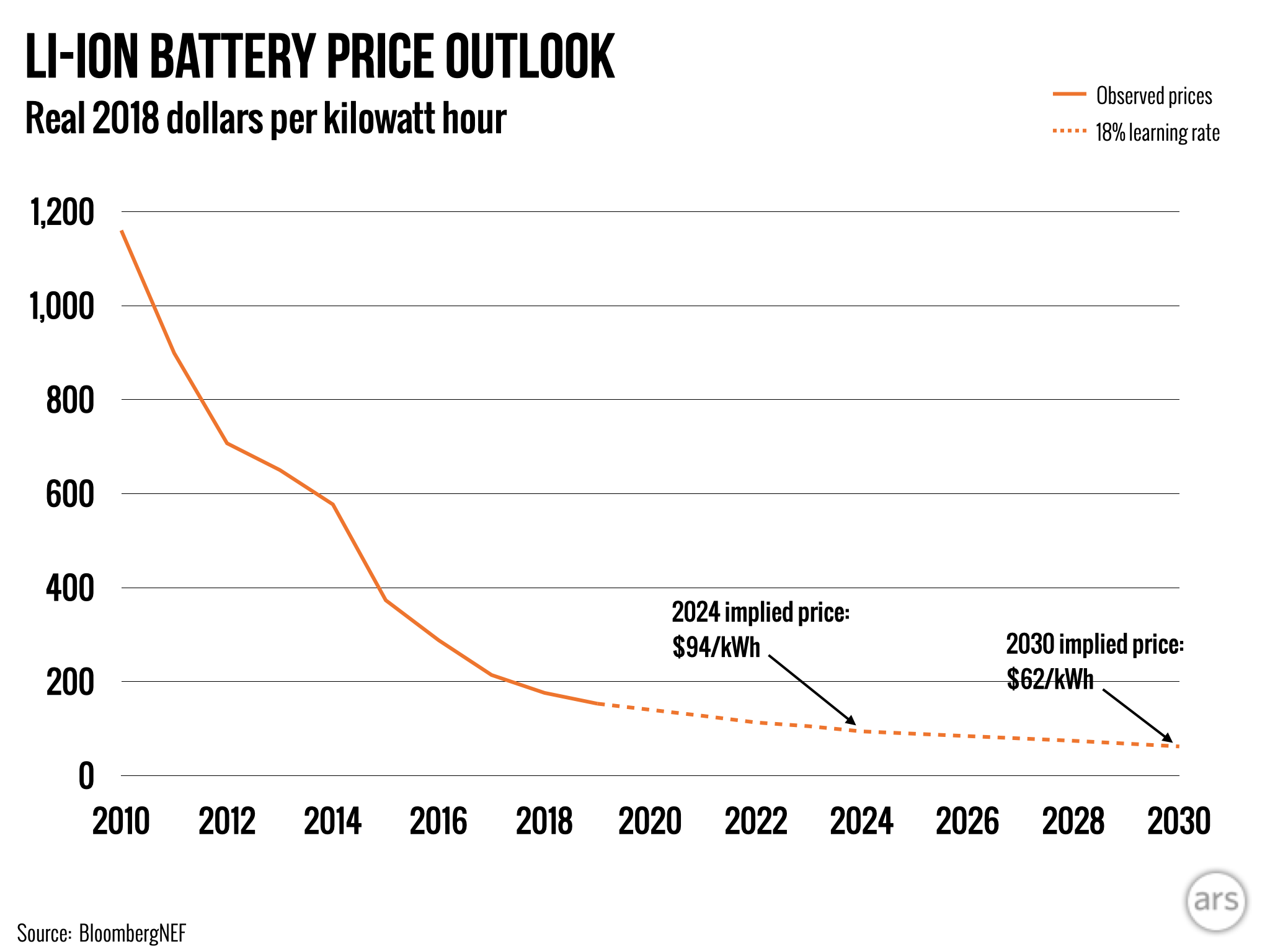
Battery prices have dropped 89% since 2010. BloombergNEF has predicted that, with battery costs continuing to decline, EVs will be less expensive than ICE cars by 2027. UBS predicts 2024.
I would like to see a source for the first claim. If I recall correctly from my parent's expertise (energy domain) an efficient large power plant (~60-65%) can be ~ 1.5 times more efficient than a modern ICE engine (averaged, Diesel being better than gasoline, around 40%). 3x would push the efficiency over 100%.
Not OP but he’s correct if talking about how much energy actually moves the car —- IC engines are indeed ~40% efficient but if you’re measuring the energy that actually moves the car it’s more like 23%-25% due to all the parasitic and drivetrain losses. So it’s completely plausible for a power plant to be 3x that.
Of course some of those losses would also apply to EVs but still, “wasting” 3/4 the energy of a highly refined, carbon intensive product is a pretty low bar.
Can't find it now, but you are probably right for newer and well maintained ICE engines. I'm guessing that the 1.5X-3X range I saw includes old and badly maintained engines. They could also have been measuring overall fuel to wheel efficiency and including a ~15% loss in the transmission and drive train and maybe also including average time spent idling (which doesn't apply to EVs).
Keep in mind that there are a lot of shitty cars on the road. A power plant's engine is going to usually be well tuned and maintained because small increases in efficiency can be worth a ton of money when you are generating tens of gigawatt hours per day of power. How often does a typical driver of a middle-aged car take it in to be tuned with the objective of maximizing energy efficiency?
I bet the average gap across all cars on the road and including transmission loss is at least 2X.
Also it's tough to argue against the second point. Look into how much power is used in the oil to gasoline supply chain, especially if the oil is coming from heavy oil that requires an additional cracking ("upgrading") step or fracked wells that require a lot of energy to drill and hydraulically fracture. I recall reading an analysis years ago arguing that the Canadian tar sands are almost an indirect natural gas to oil conversion operation rather than a net producer of energy. A huge amount of gas is burned to get that stuff out of the ground and into a form that refineries can handle. You could instead just burn that gas in a combined cycle power plant and run EVs with it and emit a lot less carbon.
Thing is when you are buying any oil product you are really not buying energy. It's ridiculously expensive compared to energy from any other source. You are buying conveniently stored energy and paying a huge markup for it.
I think the only really sustainable car is the one that doesn't exist. Regardless whether your car is electric or ICU it's just a method of transportation that is wasteful of energy and resources and doesn't scale.
Just because it's cleaner doesn't make it clean. My point is that we should be asking questions about the impacts so we can minimize the negative ones.
For example, where is the energy coming from to charge those batteries? Even if we say wind or solar, those devices end up in landfills. Maybe we should look at making these devices recyclable as an integral part of the strategy.
It's okay to point out problems with a path to the future. It's also okay to still take that path even though it's not perfect. Eyes wide open. Lesser of two evils.
The problem is that in open conversation like this a simple statement like 'Yet here we are talking about a lithium mine, which is not clean' is insufficiently contextualized to know where the commenter is coming from. Are they just trying to be transparent and realistic? Are they someone that has no dynamic range in their understanding of ecological harm? Are they long in petroleum and want to throw interference up at any point where electrification of transport comes up? Are they just being a contrarian troll?
I'm saying "lithium recycling" isn't yet such a benefit that we don't need to keep mining additional lithium.
Not to suggest OP was doing this, but it seems a bit weird to start your mouth watering at the notion of "I can't wait to strip 11 million tons of rock out of the side of this mountain, melt it down and refine it, so that we can start being clean with it by recycling."
A big factor there is that demand for Lithium is growing drastically and we don't really have that amount of Lithium pre-mined and ready to be recycled in the first place.
Can you go into detail as to how specifically it is not clean, and how it compares to the resource extraction of other things like steel, aluminum, oil, etc.
If people want truly green infrastructure, the only practical options are nuclear power and densification -basically turn as many cities as possible into Paris. LRTs don't need batteries because they're hooked into the grid with catenary lines, subways have 3rd rails, bikes run on human, and e-bikes use only tiny batteries.
And while nuclear power isn't ideal, it's the only tech that has fully decarbonized power grids at State level.
Otherwise we need battery power on an utterly insane level.
This was the common mantra ca. 15 yes ago on Slashdot that made you look extremely in-the-know, with that ineffable quality of genius that cynicism is often mistaken for.
My point is that nowhere has successfully done it. No jurisdiction that I know of has completed a changeover to zero-carbon emissions power based on their wind/solar production, while there are several that have been quietly humming along on 100% nuclear for years.
While there have been massive advancements in wind/solar, the only tech that has been successfully used to create the backbone of a zero-carbon power-grid is nuclear.
Interestingly if we have significant excess production from intermittent sources we can reduce our battery needs. Last I read the best cost/benefit ratio was something like 7x the energy production.
That said nuclear base load makes a _lot_ more sense.
I point to nuclear power simply because it's already proven to work. Overbuilt wind/solar should work in theory, but primarily nuclear-powered grids exist right now.
Where did you read that? Methane which already powers 40% of the US electrical grid can be created and then turned back in electricity in a Electricity→Gas→Electricity process with a round trip efficiency of 30–38% [0]. There is no way you'd need 7x production when you can use surpluses to make methane or hydrogen.
There's a whole spectrum of energy storage tech where the tradeoff is efficiency vs cost. At the extreme end of high cost with high efficiency you have magnetic energy storage, then slightly less-efficient but lower cost you have batteries, then in the middle you have things like synthetic methane, cracking hydrogen, and pumping water up-hill, and at the bottom for lowest-cost and lowest-efficiency you have compressed air.
Finding the right balance of overbuilding supply and storage efficiency is going to be a long process.
The goal was to have a long term hydrogen, mid/peaker battery setup with the minimum cost while providing for the entire grid.
Unfortunately I didn't take notes as to what the source was and I read this about a year ago. Google has been entirely useless as I've tried to dig it back up.
We can't turn US cities into Paris. Turning into Paris requires infrastructure, like subways and the like! But between tariffs on things like steel, gross administrative incompetence, labor union shenanigans, and environmental review laws, the US is incapable of building such infrastructure.
Someone's going to complain "but environmental review is important to protect the environment!" which is why NYC's congestion charge is going to be delayed and litigated for the next 10-20 years in environmental review while cars stuck in traffic spew pollution into the environment.
And someone's going to complain about me mentioning labor unions, too, and admittedly they're sometimes a small part of the problem (when not suing under the environmental review laws) but the Second Avenue Subway still had to give the unions a six-figure payout for using a tunnel boring machine, and every crane has to have someone employed as a full-time oiler because it's still 1910 and we're on steam power. European labor somehow manages to avoid these levels of absurdity.
Not that this is necessarily the top problem. The notoriously free-market pro-business right-wing New York Times (cough, cough) brought over the guy who was in charge of Crossrail, and he was shocked at how many people were standing around the dig site doing nothing. The MTA had no idea why most of them were there getting paid. The MTA also has a bad habit of completing Phase 1 of a project, letting all the contractors who know anything about it go on to other projects, then starting again from scratch on Phase 2 a while later, so that there's absolutely no in-house expertise.
> Also don't forget, many people don't want to live in a crowded, noisy, dirty, disease ridden city.
I dispute that cities are necessarily dirty and disease ridden, particularly the latter. There are models for cities that would work in this regard (e.g. Tokyo, Singapore).
That said, I don't necessarily have much sympathy for the notion that we shouldn't rely on electric cars -- we should just do the simpler option of completely restructuring American cities and reallocating vast numbers of people. Which would be overwhelmingly, unfathomably expensive, as well as rely on people actually wanting to move to the new cities. (Or forcing them to, I suppose.)
Speaking for myself, I like having a bit of space. My very long term goal is to have a house or cabin in some decent forest, secluded and private and peaceful. City life just isn't appealing.
edit: and I'm not saying that cities are our only option, I'm saying that cities are our only option if we want to avoid having to create and maintain an utterly staggering amount of batteries.
> We can't turn US cities into Paris. Turning into Paris requires infrastructure, like subways and the like!
Houston famously has the largest highway in the US - the Katy Freeway (I-10) is 20 lanes + 6 frontage lanes at its widest, and it is an absolute eyesore [0]. Despite the almost $3 billion spent to expand it to 26 lanes, traffic has only gotten worse because of induced demand and the fact that cars are a horrendously inefficient way of moving people since the vast majority of traffic will always be single-occupant. Once you need two lanes in either direction to "fix traffic," you will never be able to keep up with demand unless the area depopulates.
Houstonians who rely on public transit find that their mobility is severely impaired. This is because our suburban sprawl is fundamentally incompatible with the "transit must be partially/wholly sustained by fares" logic which has been employed since the systems began to fall into public ownership as private operators began folding during the post-WW2 white-flight to the suburbs.
Even if you have self-driving electric busses (no driver to pay), you cannot provide sprawling neighborhoods with large minimum lot sizes and detached single-family homes enforced by zoning restrictions "good" bus service simply because of the capital required to purchase enough vehicles to run into these low-density areas regularly. And it should be noted that sub-10 minutes is the headway you need to provide for people to routinely take transit over their car because that feels frequent enough that people don't plan around the bus [1]. More than 20 minutes, and you have lost most potential riders. But in many cities, even 15 minute headways are the exception, not the norm. My home county has a total of 5 bus lines that run once an hour and stop at 8 PM, so the only people who ride it are those without cars. The city I currently live in also has lines that run once an hour (despite having a population of ~850k vs 160k).
So at this point, you might be thinking that America is forever doomed to repeat the abject failure of 20th-century urban planning. But that's not the case: Houston wasn't built around the car, it was destroyed and remade for the car. Like other American cities, if you look at photos of downtown from the early 1900s [2][3], the roads were much smaller, and things were at a human-scale. Photos from the 80s [4], by comparison, are filled with massive roads and parking lots to an almost comical extent. Of course, downtown Houston is nowhere near that bad today [5], but there is still a ton of land producing next to no tax revenue for the city because they are only used to store cars.
My point is that our cities weren't always like this. We can fix them. Yes, it costs money, and yes, it is temporarily inconvenient, but we spent hundreds of billions, if not trillions, rebuilding our cities around the car, so we could easily fund comprehensive public transportation, road-diets, bike lanes, and highway capping (or even outright removal) projects by raising taxes on the rich and eliminating wasteful spending like that which regularly occurs in our defense industry. It means a fundamental change to the American landscape again, of course - the reason we even have large, sprawling neighborhoods that cannot be retrofitted for good public transit is a byproduct of previous federal policies (like red-lining) and zoning restrictions - but as we head towards a climate catastrophe, we have to do something, and it's cheaper to pay up now. Electric self-driving cars will not get us out of this mess; private industry cannot begin to save the environment on its own, nor is it in its best interest to do so.
> The city of Milan built a new subway line, and some of the cheaper subway stations cost €8 million. The city of New York added a single wheelchair ramp to Avenue H which cost $14 million.
This is in large part because the MTA is a state agency. The city has little real control over the MTA. Because the NY legislature is in Albany, they are entirely detached from the realities of city residents who have been hoping for change for decades. Andy Byford is a great example of this: he spearheaded the single greatest increase in subway speeds in a generation, and the SPEED team he created has continued to increase speeds across the system [6]. He is also the reason CBTC is being deployed much more widely across the system [7] (relative to its deployment when he was appointed), and anyone who has taken the 7 or L at rush hour has seen the effects of that: trains run so close together that they oftentimes have to stop and wait for the train in front of them to exit the station.
And Cuomo ran him out of town because he realized Byford was the one getting good PR, rather than the media worshipping him. It's not often that you find people who genuinely care and are able to manage a juggernaut of an agency and make meaningful improvements while warding off meddling attempts from a hostile boss, and I doubt another one will come along for awhile.
There are a lot of reasons the MTA has such high costs. It's basically death by a thousand cuts - many individual laws that, on their own, increase very little, but as a whole have ballooned things to an absurd degree. And because the state legislature doesn't take the MTA to go to work in Albany, they have no reason to try and improve it. There's also a large rural vs urban divide in the legislature, which ultimately makes fixing the cost overrun problems about as easy as making bidding on DoD contracts more competitive.
Really, the best thing that could happen is for the MTA to become a multi-state agency because it already serves NY and CT (via MNR), and NJ gets the shortest straw despite having tons of commuters who would love to not have to drive. Regional planning is next to impossible with the current situation. Combine PATH and the MTA (at minimum), ideally NJTransit as well. Imagine being able to board a train at Trenton and through-run all the way to New Haven or Montauk. This would revolutionize passenger rail in the region, and because all three states would have to agree to such a venture, it would allow side-stepping many of the cuts that plague the MTA today without having to explicitly repeal the legislation. (Not that it would eliminate graft, of course - PATH has plenty - but it would reduce a lot of it.)
But more realistically, the most likely thing would be for the MTA to return to city control. It would likely be much better since local politicians actually use the system and can be held directly to account without the rural vs urban state divide that encourages not improving the status quo, but would still suck for everyone across the Hudson.
Suppose 150k mile car that averages 30mpg. That is 5,000 gallons of fuel weighing 30,000 pounds. The amount of crude to make that oil varies, so actual oil you have to extract and ship and refine will be a bit more than that, and the refinement process is also dirty.
So compare that 30,000 lbs of oil to the amount of lithium in a Tesla battery pack, which is about 138lbs. 138lbs < 30,000lbs
Then figure in that those 30,000lbs of oil all go into the air producing not only c02 which is changing our climate, but particulates which are bad for our health and cognitive function, vs the lithium in a battery pack which can be recycled and/or re-used
This seemm like a large net win to me.
All of that said, yes, all of the resource extraction industry, from the iron and aluminum to the oil and lithium, has a bad history of responsible stewardship of the lands they exploit, and I support forcing them to do a better job.
> So compare that 30,000 lbs of oil to the amount of lithium in a Tesla battery pack, which is about 138lbs. 138lbs < 30,000lbs
I think you need to account for the amount of material that was mined to get to that 138lb battery. My understanding is that it's orders of magnitudes more than what gets removed/disrupted for oil. I don't know the figure (and I welcome someone telling me) but I think it could well be in excess of 30,000lbs of raw material mined.
There's also battery recycling to consider.
I don't know which way the result swings; I'm just saying that it's much more complicated to figure out, and far less clear cut, than you suggest.
Yes a complete accounting of the net externalities of each would be very complicated, and I apologize that I am not prepared to present a 200 page research report here in the forum. A bit of napkin math can go a long way.
How much dirt you have to dig up to get a thing isn't really much of a measure of impact though. If I dig up 50,000lbs of dirt to get 138lbs of lithium, but the dirt just goes back to being dirt, no problem. If on the other hand sulfuric acid leeching makes it an uninhabitable wasteland for years, problem.
But yes in the end, recycling batteries is going to be the real big win, where all the components can be reused rather than mined.
That is true. However much of that stuff can basically be piled and is not really damaging to the environment. Lithium is usually only about <5% of any given rock.
That is far better then blowing tons of things into the air. Its just a stack of crushed rocks.
I wish that the damage of lithium mining would be specified and put into specific terms about what the damage is and what's it's doing.
For example, fracking in California results in 26 acres of toxic storage pools that are leaking and contaminating ground water with specific toxic chemicals:
However, every single story about the toxicity of battery production remains vague and I haven't been able to find any that specify what the damage is. I have found that indigenous people are having their land used without much permission or process, but the damage has never been specified.
Does anybody have some specifics about what's going on? Presumably there must be an environmental cost but it's really unclear what it is, or how it compares to the regular destruction that we embrace from fossil fuels.
Let’s hope it stays that way. But $1.5B is not a tiny sum and I’m willing to bet the government will bend over backwards to bring a bunch of “jobs” to the area at the expense of all environmental concerns.
Greedy lobbyists in the state capital would object to this. Ecotourism is seen by voters as one of Maine’s largest industries. Much of its real estate industry and its most well-known brand (LL Bean) relies on it.
You have a delusional believe in the power of lobbying. Establishing a mine in the US is incredibly hard. Even in places with existing mining, establishing a new mine is a major undertaking.
Mines even in mining friendly places is very, very hard. Doing it mining unfriendly places where you have real popular opposition is bordering on impossible.
Yes, neither option may be perfect. But just claiming that, therefore, they are equally bad is philistine. It's a full embrace of a talking point even ExxonMobile has retired.
It's a very misleading statement to bluntly compare a consumable Ressource with a recycle metal.
While it is known that lithium itself has environmental issues the potential reuse and benefit of pulling it out of the earth to make batteries will have a very long and positive outcome for us.
And to a certain degree the initial disruption might be totally worth it in the long run in comparison to stuff we just burn away.




At least the lithium deposit near the Salton Sea is already in an area that's an ecological disaster. It makes sense that Maine would want to protect their natural resources.