> I’ve seen generations grow up. Some grandparents come in with their grandkids and say, “Anna, remember the jukebox?”
    > Today, however, young people no longer come to the bar. They came when we had the dance floor and the music. Today, they like to spend time with the smartphone; they even take it to bed when they go to sleep.
What are we losing, what are we taking away from life, now that we ourselves have become a resource to extract. Probably, a lot.
> Today, [young people] like to spend time with the smartphone; they even take it to bed when they go to sleep.
Recently my parents (in their mid-60ies) were visiting us. At some point I realized that both of them had been quietly sitting at our dinner table for over on hour, eyes glued on their smartphones. They are massively addicted. I have noticed that they get nervous as soon as the smartphone is out of reach, or even in silent mode. They mostly talk to friends via Whatsapp and are in constant fear that they miss out on something or that these friends (which also seem to spend most of their days on Whatsapp) will be offended if they don't reply within 5 minutes to the latest Whatsapp trivia. It is quite a struggle to even get them to turn off their phones when we are having dinner. The Whatsapp messages just keep coming in. My wife recently learned that her mother mostly spends her evenings with posting photos of her life on social media, and broke off contact with her brothers for a few days because they failed to quickly and enthusiastically react to some photos she posted on a family Whatsapp group.
But I guess for Anna Possi, our parents are "young people" and could be her grandchildren...
I feel like she's comparing the young people she sees today with the young people she saw 20/30/40/50 years ago. Not today's young people with today's older people. As you point out - people in their 50's/60's tend to be addicted to their phones too and in my experience have even less etiquette when in public or company.
And it's probably notable bc youth is marked by the energy and spirit you have that becomes hard to maintain as your body grows old and weary. Old people swapped reading and knitting and cards and yapping for smartphones, while the youth swapped dancing and singing and meeting new people for smartphones.
I agree with you, the infection hit quite a lot of older people very hard as well. I have problem getting some 40somethings to meet in person, even in professional contexts, they are just so soaked in a WhatsApp maelström of utterly irrelevant messages that they are conditioned to answer NOW!
That said, the core of the message should not be judgments between the young and the old, but the problem that we have introduced digital fentanyl into our pockets.
You're right, as is your parent comment, in saying that this isn't something only the young suffer from. In fact it's everywhere; the people with the worst smartphone addictions near me personally are an 11 year old and a 70 year old...
That said the message, when taken as a general progression between how life was then and how it is now, stands.
The same thing happened with TV in the 80s/90s. It will eventually fix itself, Gen Alfa will grow tired of smartphones when they will be in their thirties, I'm pretty sure.
(that doesn't mean that there should not be active campaigning to point out the risks of smartphone addiction)
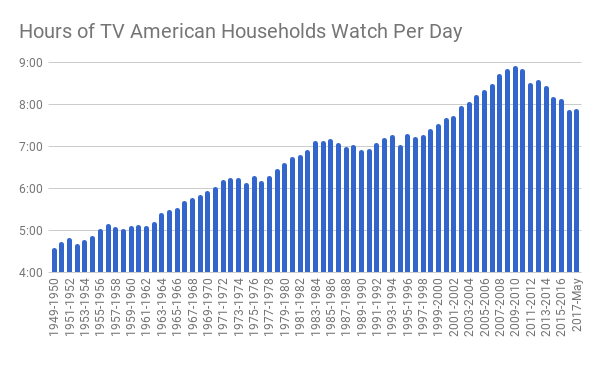
TV use was higher in the 2000s than it was in the 1980s/1990s. TV viewing hours steadily rose from 1949 until finally peaking in 2010.[1]
But when TV finally peaked in 2010, did overall screen time go down? No. It kept going up.[2] Obviously, this is when the masses went all-in on smartphones, social media, and the internet.
Screen usage basically never went down. It has only gone up.
So I only see anyone getting tired of smartphones and actually using them less if they've found something more addictive to replace them.
You have a good point I overlooked, thanks for the correction. I actually missed the "TV was just displaced" angle, which makes sense both statistically and anecdotally, if I think about family and friends.
TV also had a social aspect that internet does not have by construction: You had the same program on only a few TV channels and this was funneling people to talk about similar things or have discussions about the previous day show.
These things rarely happen organically anymore unless "forced" in one way or the other...
A friend of mine's kid (maybe 10 years ago) started crying when he watched regular TV for the first time. He literally thought the TV was broken when the commercials came on with the volume cranked up.
It's the same now with fb and these other old format social media sites. People just stop doing it. With that said I literally think fb will be with us for another 50 years as the people who are still on there are great marks and they won't be leaving until they 'age out'.
It seems we (America) are in some kind of “middle”, or at least a phase change in a larger wave of the addiction cycle, with different stages affecting different generations and countries based on arrival of what can be described as the addiction dealers, “Big American social media”. It reminds me of the effects of the crack epidemic rippling through different generations differently from the late 70s to this very day still.
I don’t have hard data to substantiate it and my theory is based on anecdotal conversations but it seems, e.g., where there is some recovery going on amidst something like American millennials, who have both dealt with their own addiction and were the first generation that is also dealing with the neglect of addicted parents, they are also to some degree recovering (“reparenting” themselves), to some degree probably also spurred on by realizations shot the deleterious effects of phones and SM that come from exhaustion and different life stages. On the other hand, other generations of Americans, like those now elderly parents of millennials, not only are still, but increasing number of them are entering the earlier stages of “phone addiction” (which encompasses many different things), with the most tragic part being that they are in the latter quarter of their life and are unlikely to even realize, let alone recover from the addiction.
I also see this cycle and these stages emerging in other western societies in particular. My theory is that it is a particular effect or amplifier of the underlying culture to some degree, i.e., adoption, degree, impacts. It seems particularly pernicious in America because the underlying culture (if you can call it that, after decades of it being poisoned and corrupted by corporations and the government) was and is fertile ground for the societal rot caused by social media and its amplifier, smart phones, to have taken hold and spread like the virus it is.
It was even all described as “viral”, and yet we still engaged in it as if unfamiliar and investigated viruses spreading in an uncontrolled manner are a perfectly acceptable thing that should not even give anyone pause, especially if money can be made, regardless of whether it is something like HIV, with a very long lead-time, a delayed ETA for the reaper.
What happens now that we are in some kind of middle stage of the “smartphone“/Social Media civilization wildfire, with the first to have been affected looking over the devastation it has left in their wake, Shell shocked by the neglect and destruction, as the inferno is still raging on off in the distance as it consumes their parents and new generations, and even toppling whole countries through the “Color Revolution” playbook?
English has ae in Maelstrom but the contemporary word in Danish, Swedish and Norwegian is Malstrøm/Malström. I wonder when it lost it's ae, I see Mahlströmn from 1698, reading the etymology it says dutch but I wonder if they just wrote it down first. Everything about the sea is always filled with mythology.
I think social media needs a less poetic word though.
I would say that the ae comes from Dutch, it was the way the open a sound used to be spelled before it became aa (maalstroom). You can still see it in place names (Aerdenhout which is pronounced Aardenhout).
It never had the ae in swedish and danish. Its from male/mala, to grind or to mill. English somehow changed it to ae, maybe through dutch where its maalstroom.
The OED agrees about the Dutch idea, giving the etymology as:
"early modern Dutch maelstrom (now maalstroom) whirlpool < malen to grind, to whirl round (compare meal n.1) + stroom stream n"
and also thinks Dutch is the origin, with Swedish/Danish etc taking it from Dutch too:
"The use of maelstrom as a proper name (also in French) seems to come from Dutch maps, e.g. that in Mercator's Atlas (1595). There is little doubt that the word is native to Dutch (compare synonymous German regional (Low German) Maling). It is true that it is found in all the modern Scandinavian languages as a common noun, but in them it is purely literary, and likely to have been adopted from Dutch."
Yes, it seems to be everywhere. Like an epidemic. When I pick up my daughter from school, I have to wait outside the entrance for about 10 minutes with other adult parents. Nine out of ten parents just stare at their smartphones and don't even look at me. In the past, people would have started a conversation out of boredom and gotten to know each other. We are really losing so much.
In the context of the above posts, which is young people eschewing dancing in favor of using smartphones, old is an adult that is expected to behave at or near peak maturity compared to a younger person whose is just coming into their own (presumably 20s).
My parents were like that, in a different way. They couldn’t sit in a room without a tv on, even if they had visitors and everyone was talking and not paying attention to the TV. Living room TV was on at least 16 hours a day, just about every day, I bet. So weird. Also had TVs in every bedroom, including rarely-used spare bedrooms. Like they had six TVs in their house at peak. WTF.
(Actually, my in-laws also do the TV thing, or else a laptop playing YouTube trash… plus phones)
I have recently moved into a new accomodation, and my neighbour is an elderly Italian lady in her mid 80s. Our first conversation was about how estranged she feels nowadays that everyone around her, young people but also middle-aged adults, are unable to connect not only with strangers but also among each other, filling every minute of their lives with a smartphone. Even the doctor's waiting room or Sunday mass doesn't feel the same, and she has to force people to snap out of it and just put the bloody phone down. She asked me how did I cope. I said I didn't, really.
We had a beautiful conversation about that as it is a topic that I think about a lot, yet whenever I breach it with any "adult" (millennial or older) the response I get is either a shrug, or denial. Weirdly enough, it is an easier topic to discuss with the younger generations, those that have grown up in the YouTube era, yet deep inside feel there is something crucial that's gone lost in our society and we haven't even started trying to recapture it.
I have always believed the millennial generation to be the only one to do something about it, as it sits right between the major societal upheaval the internet has brought. The older generations are lost to Facebook and inertia, the younger have never even seen the world of before.
When ever in the history of the world were humans not exploited by other humans, in much worse ways than now? I'd rather be google's data source for ads than be someones actual slave for example.
Also I don't really like these luddite sentiments, usually shared between the two extremes, old ladies that never used the internet so they don't understand what they are missing, and IT guys that are too jaded to see the benefits and are at the stage of "wanna become goat farmer". Outside addiction the internet is great.
Some argue you're still one, they give you just enough crumbs so that you shut your mouth and bow your head while you work from birth to death, being taxed every step of the way, with more and more limited privacy and liberties. Meanwhile the top 1% still live like kings, laws barely apply to them, they're in charge of everything even though most of them haven't been elected
I would guess an actual slave would find that comparison horribly offensive. And kings were born into their position, but there is quite a bit of churn in leadership during my lifetime, so I struggle to see that equivalence either.
You can compare anything. Being outraged at comparisons is the most basic reply to anything. You thinking something isn't comparable to something else is in itself a comparison. At least make an argument.
..."It is exploitation but at least it is not slavery" is a (let me put it frankly for you seen as you need it) shit argument that justifies and proves nothing.
To expand, I wonder whether people will wistfully look back on their days browsing tiktok and shitposting on HN compared to whatever they and their kids / parents will be doing in 20 years.
"now that we ourselves have become a resource to extract"
I take your general point, but I'm interested in what you mean by "we" here - the general population or HN readers? People have been a resource to extract from since the beginning of farming, and particularly so since the beginning of the industrial revolution. The difference is perhaps that the attention of rich, western people is being exploited now and is causing this particular concern. Read any first-person accounts of the industrial revolution and the idea that this is anything new falls apart.
> now that we ourselves have become a resource to extract.
This has nothing to do with what you quoted.
Smartphones and their effects are orthogonal to your point. Before smartphones if you were at home you were alone, isolated, and bored, so you went out and met your friends. With smartphones you are always connected to your friends or others and it seems that it reduces the psychological need to meet in person (it's no longer the only option).
That's overly simplistic, people don't go out because they slack 24/7 in front of a screen, not because they're connecting with their friends through their smartphones. From my limited experience 70+ years old spend the whole day in front of youtube/facebook/alternative tv channels mostly watching infotainment that's at best brainrot and very often full blown conspiracy theories / propaganda. Boomers are even worse than teenagers when it comes to that, they're the most gullible and easily screen addicted demographic out there
The simplistic and beside the point claim is that this is all "we ourselves have become a resource to extract". This is both not new and not key, and more of a political rant.
Before smartphone there was TV and cable TV. Young people spent time in front of the TV but TV is passive and does not allow you to connect with others.
Old people spent their time in front of the TV, before that they spent time by the radio, etc.
The youngest boomers are in their 60s now (and people in their 70s are boomers) so not sure if your really mean "boomers"...
What is the relation between all that and "now that we ourselves have become a resource to extract" in relation to smartphone use and changing socialising habits? This is a very shallow and short-term view. People like scapegoats and shallow reasoning.
Ubiquitous smartphones are a fundamental shift irrespective of the big bad capitalists who are doing nothing new.
Perhaps we could add parenting. If parents let their children hold on to their smartphones 24/7 it's no-one else's fault. In general, at least in my case and my friends', TV was highly "regulated" at home.
Went to Japan recently and the young women take social media (particularly Instagram) to a whole nother level over there. They very clearly invest a lot of time and energy into getting the best photos. A lot of the young men just look defeated.
I always find this argument dubious at best. It's akin to saying "A dude was wrong once 2000 years ago, anything new is progress, and progress is desirable".
Maybe we are talking about the same thing, but my intent was to say that original quote was in the theme of "kids these days...".
Not all progress is desirable, of course, and smartphones have their own problems, but same was told about younger generations and internet, TV, newspapers, etc. But those generations grew up out of it and personally I'd argue that smartphone addiction is not only young people problem.
Socrates said no such thing, no writing of Socrates has survived. He was just a character is Plato's book, Phaedrus.
Please do find the original paragraphs before accusing Socrates of this. https://standardebooks.org/ebooks/plato/dialogues/benjamin-j...
Of course, you can read and interpret that same book a thousand different ways, like he was talking about knowledge not being the same as writing things down, or whatever you want. But we don't even pretend to read the things we talk about. We just repeat nice narratives we have supposedly read somewhere else, digested by someone else, somehow.
And he would've been right. Any new advancement in technology brings societal change, and it is possible to reach a point of diminishing return, where the bad sides outweigh the positives.
I wish we could, as a society, have a serious conversation about this effect without resorting to name calling ("Luddist nonsense") and straw men ("but what about penicillin?")
Second that. I see that as a failure of society or democracy as a whole - that we are no longer able to have that broad, public conversation and act accordingly. Why should every "innovation" be shoved down our throats, if we don't want to?
I would place this blame on academia. They're the ones that are supposed to think difficult questions, and drive change. I guess today any serious discussion would just get lost in the ocean that is the Internet. Only echo chambers get reinforced.
Blaming academia is misguided, and "drive change" has never been in their job description until Progressivism took hold. The problem is each one of us: we want to numb out more than we want to do something hard. The problem is also philosophical/religious: we have collectively decided that virtue is following our animal desires (what makes you happy), which is the opposite of historical virtue. I think this can be traced back to the prevailing nominalist utilitarian view: matter is just what we make of it, and since there is nothing higher than matter, the only ethic is greatest happiness. So now, as a society, we do not really have any way to articulate the problem we intuitively feel, because the problem is that our underlying philosophy does not work, but we have even forgotten (societally) the other philosophy that has historically worked, so we cannot easily get back. I think this accounts for the interest in Stocism and traditional Christianity (especially Eastern Orthodoxy), since both unequivocally say that being enslaved to your passions (animal desires) is not the good life.
Huh. I blame it on the influence of money. Money flows easier when hysteria (really any level of un-rationalized fear) and its peers abound. It is hard to have honest rational objective discussions these days without the influences of earning another buck being just over the cognitive horizon.
The real explanation is that you cannot find new sex partners in bars anymore. If there's no sex, there's no reason for any kind of social life, human relations, romance, etc. anymore.
It used to be hushed because people thought nothing can keep young people away from each others bodies anyway. However, now it's apparently happened - social media, woke culture, fight for jobs...
People think it is smartphones and social skills. The real reason is men are blackpilled and stopped trying. What we are seeing is only the beginning.