I just want you to know: You're not alone. I worked at a company that had a similar experience with a highly regarded web design firm. Only difference is we did our own implementation from their designs. Working with them as an IC was even worse because they knew I wasn't the one signing their checks.
Some anecdotes:
* their new designs actually made our metrics WORSE.
* Some of their design work didn't cleanly translate to responsive web code very well, so I wanted time with one of their designers and try and come up with some quick solutions to try an adapt it to something you can actually implement. Web design firm didn't like this and we were forced to play a game of telephone between a project manager... which as you can imagine racked up a bunch of billable hours.
>Only difference is we did our own implementation from their designs. Working with them as an IC was even worse because they knew I wasn't the one signing their checks.
Oh, that makes me feel a little better about letting the agency take on the dev work instead of doing it in-house like I'd originally planned. I feared that there'd be a lot of miscommunication and confusion if my company's dev team had to resolve design issues with the external agency's designers. From your experience, it sounds like I was right to worry.
I liked your original design. Simpler, to the point, and lower contrast so my eyes don't bleed.
Also I am utterly floored at how long programming a web page takes even for these "professionals". Yet another profession that pays way better for way less work than mine (scientist).
I'll second this; the new design both lacks strongly differentiating features from countless other tech companies, and lacks strong objects to focus my attention on.
Having a picture of the product was both endearing and reassuring. The new site could just be another rebrand for a reseller of cheap Chinese schlock.
That was my immediate impression as well: no differentiation. The new site does look modern and it inspires more confidence, but the old brand had a clear personality that should’ve been preserved in the spruce-up.
I like the original one better too. Theres a picture of the product at the top instead of an abstract diagram, and it reads as more honest + less sterile.
> Also I am utterly floored at how long programming a web page takes even for these "professionals". Yet another profession that pays way better for way less work than mine (scientist).
Opinion from a web dev who has great respect for scientists: Our work isn't easy, but what you're seeing here is less reflective of the difficulty of the task than the insane variability in web dev pricing. This same body of work from the blog post could've been anywhere from a totally free template (it honestly kinda looks like one) to a $25/hr freelance job to this ripoff $175/hr agency, or even $150k+ if some inexperienced startup in-housed it and gave it months of back-and-forth stakeholder meetings. It's crazy how much variance there is in the cost and pricing of simple web projects. It's pretty much just pulling a number out of thin air and finding someone willing to pay that. It's very much a "what the market will bear" pricing model rather than "how do I recoup my education/training/equipment/etc. costs" model... i.e., it's a speculative bubble pricing with no real relationship to costs that I can see.
Certainly I think my profession deserves a livable wage, like any other. However, while my work is difficult, it's not any more so than a scientist's, or teacher's, or truck driver or park worker or garbage collector or landscaper. But more so than the difficulty, again, is the variability.
Over the last 5 years, some clients were paying me $20/hr, others $35/hr, others $150/hr (I actually had to negotiate that down because I felt like we were ripping off our clients... but my partner wouldn't budge much because it would impact his hourly rate too, sigh). That last job was at an ripoff agency similar to the one in the OP's blog post... I was getting paid that mostly to move pixels up and down a page (adjusting whitespace between paragraphs) on a simple Wordpress theme. Meanwhile, the $35/hr job had me working on everything from SQL to CDNs to in-memory caches to maintaining LAMP and email servers -- skills that were orders of magnitude more difficult than what I was doing for the Wordpress agency. There is no rhyme or rhythm to how anything in this industry is priced beyond "this is what we think customers will pay".
It is, I think, one of the great tragedies of capitalism that so much wealth and labor value is locked away in growth bubbles that invest not in social good but speculative ROI. If our society were saner, teachers, civil servants, vets, etc. would be better off than CEOs and mid-level tech management. But nope, so much wealth goes to people who ultimately contribute little to nothing to society at large. Who cares if Google launches a 7th chat app? It's all just a big ol' worthless bubble of pyramid schemes. What a waste of human potential.
Today I work at a solar manufacturing company because I at least believe in the social good of its output. If I were to switch to tech proper, I'd probably make 2x-3x the money even though my skills would be largely the same. But I don't want to do that because it feels... dirty, like I'm contributing to the overall decline of our ruthless trickle-up society, working on worthless projects that only serve to make venture capitalists richer at the expense of regular working people. When I hear my peers in big tech arguing about total compensation and stock valuation even though they already make like 5x median wage... I don't envy them, I just feel sorry that they're so detached from reality. When this bubble bursts it's going to be a eye-opener for our society, and I hope it causes a moment's pause and forces people to ask, "What the hell were we doing from 1990 to 2020? Why did we spend three decades chasing advertising bubbles while everything was crumbling around us?"
I hate to be blunt but you got scammed. Of course hindsight is 20/20 but I feel like you're approaching this the wrong way if your first reaction was to schedule a call with the scammer and amicably discuss where things went wrong.
My first instinct, would be to amicably discuss reimbursement of at least parts of the bill, which in my experience an honest agency would consider especially when they outright admit (hopefully in writing) that the work and management of the project was subpar. And in the event that this doesn't work, I'd explore my legal options.
Neither this rebranding, nor the redesign work you got is worth 46k.
Also the only mention of a contract I could find was at the end when discussing termination. It's one of the conclusions you drew, but it's crazy that the scope, deliverables and timetable were not clearly defined, especially if you are paying upfront.
Anyway props to you for publishing this, it's very useful knowledge.
>I hate to be blunt but you got scammed. Of course hindsight is 20/20 but I feel like you're approaching this the wrong way if your first reaction was to schedule a call with the scammer and amicably discuss where things went wrong.
Yeah, I'm not sure if I'm suffering from Stockholm Syndrome or if it's just easier for me to empathize with the agency having worked with them face-to-face, but I still think the events are explainable without assuming the agency was dishonest. Hanlon's Razor and all that. I think they overestimated their ability to scale down their workflows to a project of my size, and the rest was just a consequence of that incorrect prediction.
>Also the only mention of a contract I could find was at the end when discussing termination. It's one of the conclusions you drew, but it's crazy that the scope, deliverables and timetable were not clearly defined, especially if you are paying upfront.
Part of the problem was that the boundary between "rebranding" and "redesigning" is subjective. I suppose I could have said, "You're only allowed to change fonts, colors, and the logo, but you're not allowed to adjust layout," but that felt too restrictive. I agree with their argument that we should adjust the design a little bit to fit a new brand.
And if I wanted to, I could have scoped back down to a rebrand in December. In retrospect, that's what I should have done. But I felt like even though the designs went beyond the scope I asked for, they looked pretty good and they were 80% done, so we might as well just use them.
With regards to the difference between branding and web-design, it's fairly clear cut in my eyes. They should have been the ones guiding you and helping you understand that boundary as design professionals. Defining your brand identity and guidelines should have been their first priority, given what you asked of them, long before any development work.
I'm no expert myself, so take it with a grain of salt but I've been learning a lot about branding for my own company[0]. It's pretty much the same process everywhere, if you're interested in learning more and seeing how a project typically goes I'd recommend watching The Futur's "Building a Brand" on youtube[1], it's a great series and gives a good bird's eye view of the process. (It depicts a large project, but from what I've seen small projects follow the same process with less polish and back-and-forth.)
I wonder if you considered whether this agency pulls this exact playbook intentionally and repeatedly?
I don't think they are made up of honest people in the first place.
My personal guess is that this is a perfected game that they play with all their customers:
1. Give a reasonable quote
2. Start the project on a reasonably productive cadence
3. Scope creep, deliver items that are outside of what the customer wanted but proves work is being done. Withhold any deliverables that would end the project.
4. Repeat step 3 until the customer gets fed up
5. Customer terminates the contract, quickly finish the deliverables in the 30 days and wrap it up with a nice bow to reduce the chance of getting sued. Customer got what they wanted – sure, it was over-budget, but we delivered!
This company played you, and it was difficult to read the article because of how I wanted to tell you to stop being so forgiving to them through each step of the process. I think there is a time and a place to be a demanding customer.
I am shocked you had a "postmortem" with Isaac, and that you even said that Isaac was candid! I absolutely disagree: all he had for you was excuses and bullshit. Isaac's kindness, to me, all seems like part of the plan. He's there to make it look like they gave it an honest try.
I don't know why you aren't at your lawyer's office writing some sternly worded letters.
You said you'd next time go with a freelancer as one of your solutions. I'd argue you can run into the exact same problems as you described in your main post, just on a smaller scale.
In this comment:
> There were still issues, but I was prepared this time. WebAgency kept suggesting new flourishes to the design. I declined them all and told them to focus on the design I’d approved. I’m glad I did because they’d probably still be working on the website today.
I think you need to do this with every project reguardless of the size of the team you are working with.
Design companies seem to want to make customers feel like they are unskilled / unable to make design decisions for themselves, but maybe this is all experts? And I can say I have had very stubborn customers in the past, and it was good for everyone involved to have a customer that knows what they want and expects it, even if the designer doesn't really like the results as much as their own ideas.
>You said you'd next time go with a freelancer as one of your solutions. I'd argue you can run into the exact same problems as you described in your main post, just on a smaller scale.
Yes, definitely. In my experience, the smaller scale makes it easy to manage, so you can nip problems in the bud more quickly.
>>There were still issues, but I was prepared this time. WebAgency kept suggesting new flourishes to the design. I declined them all and told them to focus on the design I’d approved. I’m glad I did because they’d probably still be working on the website today.
>I think you need to do this with every project reguardless of the size of the team you are working with.
Yeah, I think it's important to be vigilant to some degree, but some people are effective at suggesting useful improvements. TinyPilot's in-house devs, for example, will frequently suggest improvements to designs or architecture that will cost more up-front but will reduce costs long-term, and I love those kinds of suggestions.
If the agency had a history of suggesting improvements and correctly estimating the cost of implementing them, then I'd be more open to their suggestions. But their track record was consistently to expand scope and run late, so I wanted to constrain scope as much as possible.
To be clear, I agree with your assessment and I would not recommend an agency unless you are a huge company as well. It's a mis-match of interests and goals.
The work I did as a web programmer for an agency (freelance) was similarly imbalanced with many "leaders" telling me what to do, (ie, project lead heavy, 1 designer, 1 programmer) and it was a mess and I won't bother with it again.
I think the key is not to hire anyone to do website design.
Hire graphic designers to make logos, illustrations, and come up with a color palette. That's the kind of stuff that can't possibly take weeks and weeks.
The author doesn't need a website design, this site is totally fine with a generic SquareSpace/Wix template.
Get your logos and illustrations and drop them in, and set your colors and fonts accordingly.
Custom website design is complicated enough that it can get into its own little version of development hell, and most small businesses don't need anything that a simple generic page can't handle.
Some feedback from a person who is the target audience of your product:
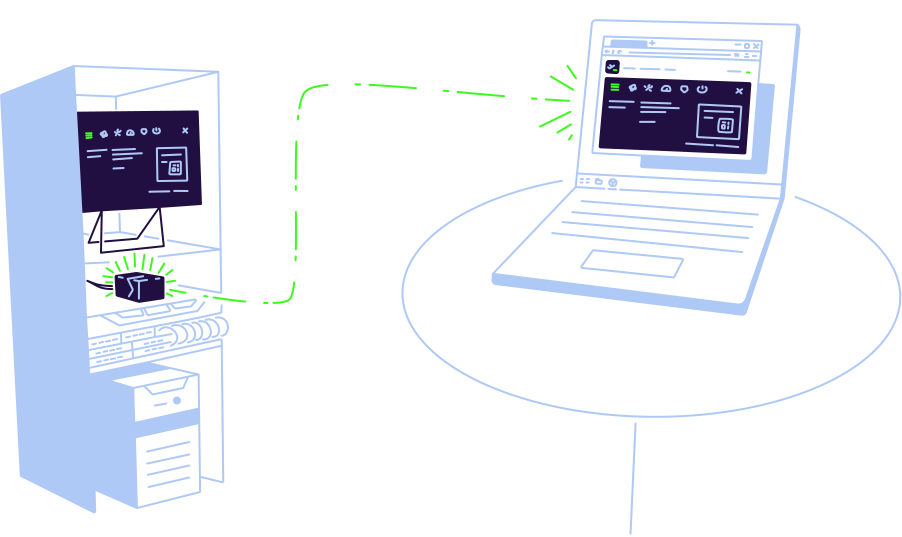
https://tinypilotkvm.com/illustrations/tinypilot-overview-il... is the most prominent image on your site and of little value in my opinion. Rather than have a sketch that looks like it very well could just be a stock image (and my brain is trained to ignore this type of image), I recommend having actual photos that show the same scene. A photo of the device hooked up to a real server (and with neat cabling if you want to impress me). A photo of a laptop showing what the software actually looks like.
Slow down the screenshot carousels a bit. They go too fast for me to be able to see what is going on. And if there isn't already, have a page with screenshots of all of the key features of the product. That's what I would want to see to evaluate what the product does.
Others have already mentioned this: the old logo was better. You can tell it was made with love. The new logo - this is a common theme - might as well be a stock image.
I appreciate the feedback, but the hard part about feedback like this is: how do I identify who's right? Half the people in the thread are saying the old design is better, and half are saying the new design is better.
If I could flip a switch and try the design you're describing and see how it affects sales, I'd try it, but taking professional photographs and redesigning the site is several thousands of dollars and dozens of hours of management time.
The data aren't entirely conclusive. My sales increased but I can't prove it was due to the new design.
I could A/B test the old design against the new, but my sales volume is low enough that it could take weeks before we get compelling results for any experiment.
It's easy to come up with lots of ideas for design improvements, but it's much harder to actually implement them and then measure the results.
The biggest problem is that the device's box looks 3d printed, and I associate that with "hobbyist/prototype" automatically. I would also prefer to see the real device over stock art, but if a picture of the device evokes unreliability, then removing the real photo may have helped for this reason.
I've been looking at case changes for a while, but it's hard to ditch 3D printing. As we iterate on the hardware the physical layout changes every few months, so it's great being able to update the 3D printed case design in a few days.
That said, 3D printing with the material we use is pretty slow and expensive. We eventually have to move to either plastic injection molding or some type of metal.
I usually get positive feedback about the case material, but I can see how it looks different from other network devices people view as high-quality.
I'm not crazy about the image, either. I think it's okay not great.
I was hoping the design agency would take more of a lead in creating a concept that conveyed what the product does, but it mostly fell to me.
"KVM over IP" is a hard concept to represent visually. If you already know what a KVM over IP is, then we can just show you a photo of ours, but if you've never heard of one before, the illustration has to do a lot of work.
Even on a regular laptop screen, it took a little too long for my eyes to grok what I was looking at. My initial impression from the photo is that this company is selling some SaaS and not a physical device.
In my opinion, the original page with the picture of the actual device made it much clearer what you were getting.
For the OP, perhaps use a color for the device's housing? Assuming the costs are the same, a cute little blue box would make it stand out in photos and give it more character than its current generic black. In illustrations, you could make the scene in black and white and have the device be blue, for example. To me, the goal should be to make that little box seem magical and unique.
First thing, thanks for your post, it has been really interesting.
I would like to ask how you made the correlation between the new site and the increase of sales, I believe that your product is a very good one and would have expected that your intended target, if anything, is less sensible to site design[0]:
>But despite all the missteps and stress, the results might justify all the pain. I expected the new website to increase sales by 10-20%, but it’s been closer to 40%. In July, the TinyPilot website hit an all-time high of $72.5k in sales, 66% higher than before the redesign.
[0] I mean it is not like you are selling fashion accesories, if someone wants/needs a Tinypilot they actually want/need a Tinypilot, and they shouldn't be sensible to the looks of the site (and BTW they would probably also want to see a picture of the HDMI/VGA adapter)
>I would like to ask how you made the correlation between the new site and the increase of sales, I believe that your product is a very good one and would have expected that your intended target, if anything, is less sensible to site design
Yeah, I tried not to lean too hard on this because I don't have rigorous evidence that the redesign caused the improvement. But anecdotally, it seems like it did.
Usually when the website sees a significant uptick in sales, I can usually tie it to a particular event (e.g., a new review, new product launch), but nothing notable happened in May or June except that we finished the new designs, and they were some of our strongest months. It could just be that we're growing over time, so maybe the same thing would have happened either way.
One other change to the website that I feel like is well-supported by this point was changing how we present our products. We used to show four products in our catalog, but in November, we simplified the website to show only our flagship product, and it was almost an overnight doubling of sales that's persisted ever since:
>One other change to the website that I feel like is well-supported by this point was changing how we present our products. We used to show four products in our catalog, but in November, we simplified the website to show only our flagship product, and it was almost an overnight doubling of sales that's persisted ever since:
This is much more correspondent to the "mental model" I have of the majority of your customers, they want/need a Tinypilot , and they get a Tinypilot (as fast and as directly as possible), no matter how the site looks.
Maybe there is a coincidence of some kind, something else that increased the visibility of the site or the knowledge of the device existing at the same time of the site redesign.
completely unrelated to your post, but just wanted to say thanks for your work on the rebooting of nyt’s ingredient parser. I use it in my project here: https://github.com/cookwherever/cookwherever (site is currently down due to the server being physically moved from our house lol). If you are interested in talking more about how i’m using it I would love to share :)