I don’t get the outrage, this is same as when Twitter and Reddit cut off 3rd party clients to push people to use their official client. The lesson is that don’t build a product that depends on unofficial APIs. Opencode got huge adoption because they baked in being able to use Claude’s max plan so people could switch with no switching costs. Why would you think Anthropic would be ok with this? On top of that, I read Anthropic cache’s the system prompt for Claude code for every user and this helps their costs.
The truth is Opencode didn’t have to bake this in. People who can will proxy Claude’s API anyways through other means.
This is true, Twitter and Reddit clients were using official APIs that got their price increased. The point still stands though, don't build a service dependent on another service and especially if you're using an unofficial API. It works if you're under the radar but Opencode is not anymore.
Honestly, it seems like this played out in Opencode's favor. They are getting press for this and people who are used to Opencode now and can't use their Claude plan might use GLM 4.7 or Minimax M2, models they offer for free.
Isn't this just a UI over Claude Code? For most people, using the terminal means you could switch to many different coding CLIs and not be locked into just Claude.
I guess they’re bringing Claude Code tools like filesystem access and bash to their UI. And running it in a “sandbox” of sorts. I could get behind this for users where the terminal is a bit scary.
Most people working office jobs are scared of the terminal though. I see this as not being targeted at the average HN user but for non-technical office job workers. How successful this will be in that niche I'm not certain of, but maybe releasing an app first will give them an edge over the name recognition of ChatGPT/Gemini.
Coke is actually very different from country to country and less so from state to state. This is because Coke uses local bottle companies and they might be using different water. The coke you buy at your local store is probably bottled somewhere close to keep shipping costs down.
If you're a fan of Dr.Pepper, you'll notice they have 2 different bottles based on where you buy. That's because in some regions, Dr.Pepper uses Pepsi for bottling and in others it uses Coke bottlers.
Honestly, the water is just a guess since the taste is different and the syrup comes directly from Coke. In other comments here, people mention the cans used but I’ve had Coke in glass from different countries taste different.
Yes, we just launched our Shopify alternative. Next is Toast alternative for restaurants, MindBody alternative for gyms, etc. We’re going to leverage these platforms to build a decentralized marketplace around those verticals.
Group 1 is untouched since they were writing code for the sake of writing and they have the reward of that altruism.
Group 2 are those that needed their projects to bring in some revenue so they can continue writing open-source.
Group 3 are companies that used open-source as a way to get market share from proprietary companies, using it more in a capitalistic way.
Overtime, I think groups 2 and 3 will leave open-source and group 1 will make up most of the open-source contributors. It is up to you to decide if projects like Redis would be built today with the monetary incentives gone.
Please note that the majority of OSS efforts where already non monetized and deeply exploited. At least, what it is happening has the potential to change the model towards a more correct one. What you see with Tailwind and similar cases, it is not really an open source business model issue, it is a "low barrier to entry" business model issue, since with AI a lot of things can be done without efforts and without purchasing PRO products. And also documentation is less useful, but this is a general thing, not just related to OSS software. In general people that write OSS are, for the most part, not helped enough by the companies using their code to make money, by users, buy everybody else, basically.
In a similar vein, I've been using Claude Code to "read" Github projects I have no business understanding. I found this one trending on Github with everything in Russian and went down the rabbit hole of deep packet inspection[0].
I got the idea from an old post on here called Story of Mel[0] where OP talks about the beauty of Mel's intricate machine code on a RPC-4000.
This is the part that always stuck with me:
I have often felt that programming is an art form,
whose real value can only be appreciated
by another versed in the same arcane art;
there are lovely gems and brilliant coups
hidden from human view and admiration, sometimes forever,
by the very nature of the process.
You can learn a lot about an individual
just by reading through his code,
even in hexadecimal.
Mel was, I think, an unsung genius.
Thank you for sharing that story. Mel seems virtuousic, but is that really art? Optimizing pattern positioning on a drum for maximum efficiency. Is that expression?
If it wasn't expression everyone would get the same result. But no one else at Royal McBee did things the way Mel Kaye did things.
Kaye had a strong artistic vision for how things should be done; he didn't want to use the ergonomic features of the RPC-4000 because they didn't align with his vision. I think he found the idea of rigging the blackjack program offensive in part for the same reason.
Speaking for myself, I have always found the story and "pessimal" instructions beautiful. It's my favorite piece of folklore of all time. Kaye and Nather are both artists to me.
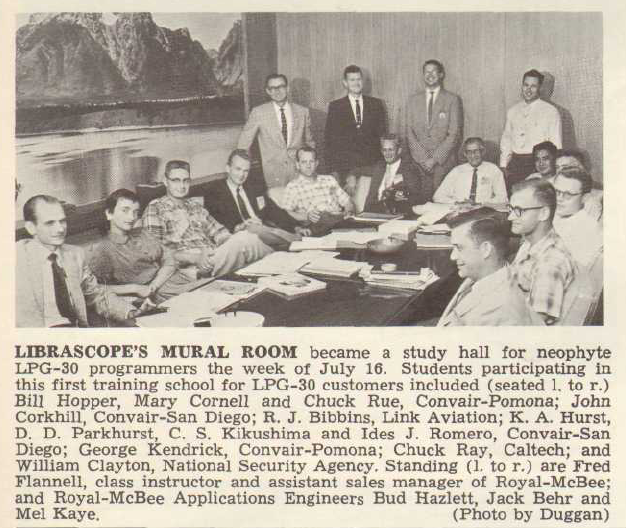
Tangentially, Kaye is standing on the far right in this photo.
If you consider engineering the art of the possible. (Yes, I know it's a politician's phrase, that's because politics is the art of the plausible ... )
I see an interesting parallel to how people think about captured encrypted data, and how long that encryption needs to be effective for until technology catches up and can decrypt (by which point, hopefully the decrypted data is worthless). If all of these documents are stored in durable archives, future methodologies may arrive to extract value or intelligence not originally available at the time of capture and disclosure.
> If all of these documents are stored in durable archives, future methodologies may arrive to extract value or intelligence not originally available at the time of capture and disclosure.
I recently learned that some people improve or brush up on their OSINT skills by trying to find missing people!
I feel the same way as this person, but I’m leaning even more into open-source. I’m building an open-source SaaS for every vertical and even though it’s open-source, we offer cloud hosting, yet most users deploy on their servers. Our cloud hosting is just one source of monetization, our main monetization is a decentralized marketplace around these SaaS.
My point is, monetizing open-source is really hard. Tailwind was giving bricks away for free while selling you a house. Given enough time, people used those bricks to build houses and gave them away for free.
My mom uses the Google app instead of just going to Google.com on Safari. She’s probably going to use Gemini because she’s locked into that ecosystem. I suspect most people are going to stick with what they use because like you said, to consumers, they can’t really tell the difference between each model. They might get a 5% better answer, but is that worth the switching costs? Probably not.
That’s why you see people here mention Claude Code or other CLI where Gemini has always fallen short. Because to us, we see more than a 5% difference between these models and switching between these models is easy if you’re using a CLI.
It’s also why this article is generated hype. If Gemini was really giving the average consumer better answers, people would be switching from ChatGPT to Gemini but that’s not happening.
All of this seems like manufactured hype for Gemini. I use GPT-5.2, Opus 4.5, and Gemini 3 flash and pro with Droid CLI and Gemini is consistently the worst. It gets stuck in loops, wants to wipe projects when it can’t figure out the problem, and still fails to call tools consistently (sometimes the whole thread is corrupted and you can’t rewind and use another model).
Terminal Bench supports my findings, GPT-5.2 and Opus 4.5 are consistently ahead. Only Junie CLI (Jetbrains exclusive) with Gemini 3 Flash scores somewhat close to the others.
It’s also why Ampcode made Gemini the default model and quickly back tracked when all of these issues came to light.
I'm pretty high on Claude, though not an expert on coding or LLMs at all
I'm naturally inclined to dislike Google from what they censor, what they consider misinformation, and just, I don't know, some of the projects they run (many good things, but also many dead projects and lying to people)



The truth is Opencode didn’t have to bake this in. People who can will proxy Claude’s API anyways through other means.
reply