I think in the US cars can increase your time with friends and family. Many people are lucky to live within a 60 minute drive from close friends or family, but without access to a car those trips become an epic trek. This is especially the case for people as they age, have kids, have a tight schedule, etc.
Furthermore, I'd venture to propose that this is not merely the case in the US. My family in Mexico City often use public transportation for work, but frequently drive to visit each other on weekends because that's much easier.
Pretty sure OP's comment assumed city life. In most rural and suburban USA towns, cars are the only thing that enables connection to others. If cars suddenly disappeared, half of America would effectively become hermits (not to mention starve due to lack of access to basic necessities like groceries).
Ending Car Dependence basically means move to a denser city, which you're never going to convince everyone to do.
No - car dependency isn’t a problem in rural areas, it’s a problem in metro areas. Places like Columbus, Indianapolis, Tampa Bay, San Diego, etc. are all completely 100% reliant on cars for transit.
People already live in the cities, there isn’t anything to convince them of for that. Instead we have to build transit that allows people to not rely on a car for their daily needs. Not that you can’t have one, of course. But walking, biking, and rail infrastructure need much, much more funding and then we can reduce how we handicap society with car-only transit.
What is interesting is that there are pockets of car free living even in these examples. E.g. in Columbus you have 45000 undergraduates at Ohio state, the bulk of whom live within a half hour walk of campus and all their friends from college, and might only use their car to shuttle themselves and all their roommates to the grocery store once a week.
I've heard it hypothesized that one of the underlying factors in why Americans romanticize the "college years" so much is that, for most, it's the only time they've ever lived in an environment (the campus) that's not designed primarily for cars.
Many of them have cars and pay for parking or if they live off campus they just park their car on the street. I would guess that 30% to 50% of those undergraduates have a car somewhere close by.
The best thing the university does is add a COTA (regional bus system) ticket as part of the tuition price to get students riding the bus locally instead of driving as they inevitably try to do.
Unfortunately, the bus service once you leave campus is comically bad so everyone just drives, catches a ride, or uses ride-sharing if you ever want to actually do anything not physically on campus. There are a lot of low-hanging fruit that the city and region refuse to take. We could run a tram from the southside all the way up to Old Worthington along the same street and you'd hit all the most dense spots in Columbus and you'd probably eliminate a lot of driving, traffic, and deaths but instead they're spending tens of millions of dollars adding new highways.
In the Netherlands you can bike between suburbs and rural areas. In the US that is hard, not only because of the distances, but also because there are no safe roads for bicycles in rural areas. It's highway shoulder or nothing, basically.
Yes, it does. Go visit the Netherlands and you'll see the remarkable difference. Just because some people are biking on those roads doesn't mean you have anywhere near the bicycle trip share that the Netherlands does.
Suburban USA towns are impossible to live in without cars because they're built with the assumption everyone has one. There's nothing inherent in lower-density housing that prevents it from being walkable, or from having basic amenities zoned to be closer to residential zones.
(Rural is a different matter, but they're usually left out of infrastructure in general)
> In most rural and suburban USA towns, cars are the only thing that enables connection to others.
I mean I suppose this is technically true. But as someone who was raised across a smatter of rural and sparse suburb and who now lives in/near dense urban areas - the urban areas are the ones having much more trouble feeling a sense of connection.
In all of the rural areas, everyone knew each other by first name, greeted each other, dropped by with baked goods. Were they dependent on cars? Yeah I guess. Feels like we missed the elephant in the room though
Even in the city its like this. Pick an arbitrary A-B in any city, e.g. go test brooklyn or chicago. Unless you happen to pick an A-B that is within a few mins walk of the same single rail line (no transfers), the car is always faster and by a good deal. Usually its like you can drive 25 minutes in a car or wait around for two busses that will get you there in an hour and ten minutes.
this hasn’t been my experience in manhattan/brooklyn fwiw. taking the subway is routinely faster. i can see the bus being slower but it’s usually not by much. You also need to deal with parking for a car if you’re not using a rideshare.
That's if you don't need to transfer. Brooklyn/manhattan example I'm assuming you are going into or out of the city into brooklyn. Look at the map, all the lines work for that sort of commute, and pretty clearly don't help you if you have a commute that isn't on this hub and spoke system.
In my city (west coast), public transport is simply not safe anymore (especially as a woman) due to lack of law enforcement or deterrents from crime. In my car - I feel safe. I am taking Krav Maga classes, but man, it didn't used to be this bad.
I think the perception of risk is what is off more than anything. LA metro for example saw about 180 violent crimes on it last year. For a system that sees almost a third of a billion boarding a year, the risk of violent crime happening is so low it doesn't make sense to consider. I expect the crime rate is similarly low on other transit systems.
That said the risk of crazy people ruining your day for no reason is not low. Ultimately the problem isn’t transit (rather it’s part of the solution), the problem is that the US social fabric is messed up.
I encourage you to check the stats, driving is one of the most dangerous things people routinely do, and nearly always far more dangerous than taking public transit.
Here's a case of rationalists misinterpreting risks based on data. Driving is a risk I accept. Being mugged or assaulted by someone on fentanyl with limited police or law enforcement on public transport is a risk that I cannot account for.
> Driving is a risk I accept. Being mugged or assaulted by someone on fentanyl with limited police or law enforcement on public transport is a risk that I cannot account for.
Why the difference? Maybe you feel like you're more in control of what happens when you're driving? But realistically however safely you personally drive, you'd still be at risk of being driven into by someone else (and there's a parallel breakdown of the rule of law where uninsured, unlicensed drivers are everywhere nowadays) and there's not much you can do.
I would rather get raped than die. Most people would.
Edit: Actually, now that I think about it, what cases are you talking about where people get full on raped on public transit? That seems vanishingly rare, if at all extent.
I strongly recommend finding a gym for Brazilian jiu jitsu, judo, muay thai, boxing, etc. They're constantly being testing and evolved through MMA fights, and they'll get you some full-contact, full-intensity sparring experience.
I am not sure I want to travel on the bus with a scared man trained in multiple martial arts. All the stats say that criminality is pretty low, I am safe on the bus, but fearful scared trained dide sounds like someone who will make it less safe for all of us.
You have no idea what you're talking about, but I'm glad you feel safe on the bus. Criminality stats are low, so the chances of being assaulted on our light rail or buses is indeed low, but it only takes one incident to lead to loss of life or injury. I'm not a "scared man", I'm trying to prepare myself for unhinged situations, which we've been witnessing at an increased rate after 2020, when our city/county reduced police and law enforcement presence.
Here's an article about the massive rise in homicides in our county since 2019 [1]. Maybe the numbers are "low" to you, but it's 1000x higher than in countries such as Japan. I won't go further into the reasons why due to risk of being downvoted by people unwilling to accept the new reality of west coast urban life.
I couldn't find historic chart for Seattle but most cities are having a similar spike in crime so I'm using NYC. The rise in crime from pandemic is from historically low numbers. The jump is big but the absolute numbers are still low.
NYC had the same murder count in 2019 as 1948. 2022 was same as 2012. The peak in 1990 was 5 times as much as last year.
You are the one misrepresenting risks. In addition to what other person said, majority of homicides is among people who know each there - people killing their own partners, families, friends, business associates and partners in crime.
I'm lucky enough to have moved, but my last home was 4 miles from the closest store, 3.8 miles from the closest sidewalk. The closest bus stop was at the aforementioned store. These numbers weren't even that big for the area where I was living. If I didn't have a car I'd spend too much time coming and going from the places I'd need to be to engage with my community.
I'd say "everyone should try living somewhere they don't need a car", but that's not feasible for everybody.
It's only not feasible because that's how the infrastructure and town planning in many urban areas has been done, and has somewhat succeeded because the degree to which you'll be dependent on a car to get everywhere isn't a super high priority for most when first choosing somewhere to live. The challenge is convincing governments and home buyers that the pros of less car-dependent cities massively outweigh the cons (which are mostly around accepting being closer to your neighbours and having less yard space/more stairs, plus governments having to focus on more than a single mode of transport when building roads etc).
It depends on the activities. I’m less active in the local outdoors group than I was but basically everyone has a car, even if they live in the city which I don’t, because it gets very old seeking out carpools for specific trips all the time.
It was the same - I just used public transport instead of the car to meet up with my friends. I never knew nor hung out with my neighbours, cars or no cars.
>Reducing car dependency will increase social activity
My social life (and sense of community) took off when I graduated from college, where I was largely living car-free, and started driving 45 minutes to my full-time job each day. How do you explain that?
Living in a car-dependent community, and choosing to go car-free, sounds like adding another layer of social isolation to me.
A big perpetrator of this is the designed environment surrounding car culture.
I moved somewhere where there's plenty of foot traffic, specifically so my kid will walk/bike to school and that is seen as completely normal.
Most Americans do not understand how horrible car dependence is for personal independence, yet defend it to the end for some reason. It's really a shame.
That doesn't really explain the changes over time in US behavior and child Independence. The US had a very strong car culture in the '50s to '80s as well, but children would still roam the streets on bicycle and on foot
It’s one thing to accomodate cars, it’s another for the entire landscape to optimize against them.
The average suburban family in the 1980s had a car. They also had well maintained sidewalks, civic organisations, and - in many cases - stores within walking or biking distance.
Post WW2 suburban communities had small roads (road width is a major factor in, i.e., how fast people feel safe driving), sidewalks, and - in general - were designed for a higher population density because this is what people wanted and were used to.
Over time, development optimised for housing and garage space with lower population densities. No one wants to go outside and walk or play if there’s no where to go.
Cars are extremely space inefficient, so when cities are built for cars it is done at the expense of more efficient transportation methods. And what you're left with in the end is a very inefficient transportation system that REQUIRES a car. An efficient system would simply make cars optional and therefore you have more independence as you have more options - not to mention a system better at moving people.
Follow Brent Toderian @BrentToderian and Bella Chu @bellachu10 on twitter for more.
it's that everything is designed around cars.
as a 15 year old i traveled through multiple countries in europe on my bike, alone.
as a 17 year old in the US i was not able to go anywhere without getting a ride in a car. any interesting places to go to were to far away to even reach conveniently by bike. everything was designed around and dependent on cars.
as a very independent youth i considered this experience an interesting lesson on what it means to be dependent, but most certainly growing up there would have been different. i have seen other youth struggling with the sudden change when they turned 18 and were expected to act like independent adults instead of the dependent youth they were until then.
> any interesting places to go to were to far away to even reach conveniently by bike.
Isn't this just a result of the country being more spread out in general? For this reason, cars are obviously useful. And because people have them... well, yes, it becomes circular. I think bikes are a pretty common thing to own in the U.S., though. Adults mostly use them for recreation, but minors definitely use them to get around. What part of the U.S. were you in? This is probably a large factor.
> as a very independent youth i considered this experience an interesting lesson on what it means to be dependent, but most certainly growing up there would have been different. i have seen other youth struggling with the sudden change when they turned 18 and were expected to act like independent adults instead of the dependent youth they were until then.
Generally in the U.S. you get your license as soon as possible (around 16), and work out whatever situation you can for a vehicle. It's true that we seem to be developing a dependency problem in the U.S., pushing maturity further and further out, but I don't think cars are the issue. Maybe in large cities; I can't really speak to the situation in those.
Isn't this just a result of the country being more spread out in general?
yes, but why is that? because people chose it that way and cars supported it. yes, it is circular. it could have developed differently, only high density urban centers where you don't need cars and large swaths of empty in between. these urban centers exist. eg. new york, dc and a few others that i am not familiar with, but contrast with san diego and los angeles and many others which are spread out for no good reason.
suburbia is the name of the disease that is responsible for this problem.
bikes are a pretty common thing to own in the U.S., though. Adults mostly use them for recreation, but minors definitely use them to get around.
sure, kids bike around in the neighborhood to visit their friends, but that also counts as recreational use. they are not using them to go to school, or to the movies or for errands, because they can't. the distances are to far.
the area i am talking about was one of those bedroom communities outside of D.C. probably the worst example. there was literally nothing of interest there, except maybe forests, but i didn't know about those because i didn't have access to a map. my friend there didn't get a car until he was able to save up for one by himself. his parents weren't poor. but they weren't rich either, so he had to pay for himself. which didn't happen until he was 18.
cars absolutely are the issue because not every youth can afford them, and even if they can, getting the freedom to move around at 16 is a far cry from 10year olds who have access to public transport
> yes, but why is that? because people chose it that way and cars supported it.
The country is a hell of a lot older than the automobile, and much development occurred before it. It's spread out in general because we had a lot of land compared to the number of people who were rapidly settling it.
> it could have developed differently, only high density urban centers where you don't need cars and large swaths of empty in between.
Not everyone wants to live in an urban center. I would be chronically depressed in such an environment.
> new york, dc and a few others that i am not familiar with, but contrast with san diego and los angeles
These are all huge cities --- metropolises --- (okay, DC is a bit of a weird one) and while they have large populations, I cannot consider them representative of the U.S. overall.
> the area i am talking about was one of those bedroom communities outside of D.C. probably the worst example.
Absolutely; this is not representative of the U.S.
> they are not using them to go to school, or to the movies or for errands, because they can't
Because they don't want to. This used to be different. Some decades past, it was not unusual to bike a few miles (say, less than 10) to get where you wanted to go. It was also not considered unreasonable to walk a few miles to school everyday, often over terrain that I see people in this thread calling "unwalkable". Society changed.
When I didn't have a license for several years, I biked everywhere. My maximum range for a day trip was about 35 miles. I don't do that anymore; it's just far more convenient to do that sort of thing in a car, especially, you know, when there's a foot of snow on the ground. But the way I see it, you do what you have to do.
> cars absolutely are the issue because not every youth can afford them
Yes, but in general, that means you borrow your parents' car, and save for something cheap. Something you repair and maintain yourself if you need to. Used auto prices got kind of crazy since the pandemic, but my experience growing up with decidedly non-wealthy families, is that people found a way.
One thing that is a real issue financially, is the insane premiums on mandatory auto insurance in some areas, notably New York state.
we had a lot of land compared to the number of people who were rapidly settling it
that, and many people came to america to start a new life away from the oppressive landlords in europe. many were also poor, meaning that they had to provide for themselves, which is easier if you have land to grow your own food. so quite naturally people favored to be away from the cities.
but modern suburbs are not that. i can understand living in the city where the jobs are or out in the country where you grow your own food. suburbs have neither of that.
i grew up in cities and on farms growing crops and herding cows. when i lived in american suburbs i found those depressing. i have been to a few places, and while DC bedroom communities may be the worst, suburbs elsewhere were not much better. it doesn't help that in movies you see much of the same. so if those suburbs are not representative, then what is?
> It doesn't help that in movies you see much of the same. so if those suburbs are not representative, then what is?
Well, I do think that Hollywood is biased towards certain demographics.
> but modern suburbs are not that. i can understand living in the city where the jobs are or out in the country where you grow your own food. suburbs have neither of that.
Many people want the city job with the space to raise kids; without the claustrophobia of the big city. Midwestern suburbs achieve that, but suburb means different things to different areas. My suburbs are not the suburbs of the coasts. Still, I would think the general logic would apply, but having not lived in such places, it is not really my place to judge. Maybe they really should just die out and be replaced.
Personally, I hate suburbs almost as much as the city; I belong in the country.
I guess, if I were to say one thing for certain: the country is large. Sweeping statements about it can be difficult to make with accuracy.
I feel like comments here are too focused on the $2 per hour aspect and not enough on the emotional abuse that this labour entails.
Sure, maybe it's an "average wage", but the people performing this work are suffering mental trauma because for hours upon hours they are subjected to reading stories and viewing images of sexual abuse, assault, gore. The people performing this sort of extremely difficult emotional labour should be taken care of. It is disgusting for OpenAI to pay so little and at the same time have such little respect for humanity and decency.
It's worth noting that OpenAI actually paid around six times that amount for this work.
It's also worth noting that Sama actually did provide for their employee's mental health. They didn't do a good job of it but trying and failing at a thing doesn't quite qualify at the level of disgust imo. Especially not for the company that was outsourcing this.
It's also worth noting that even if those of us in the peanut gallery would not trust the word of either OpenAI or Sama, it is not unreasonable for OpenAI's team to have trusted that Sama was doing what they said they were with regard to providing for their own employees mental health.
Of course images are not relevant to ChatGPT (I never specified ChatGPT), but to other models being trained by OpenAI.
From the article:
"That month, Sama began pilot work for a separate project for OpenAI: collecting sexual and violent images—some of them illegal under U.S. law—to deliver to OpenAI."
American suburban culture is embarrassing. Cities should be filled with kids living their own independent lives. Look how dutch cities are built and it's clear to see why dutch youth are the happiest and most free in the world.
>"What other engineering field has acceptable death rates?"
I'd say virtually all of them, in some form or fashion. Everything has a tradeoff. There is an acceptable death rate electrocution, if there wasn't we wouldn't allow our homes to have electricity.
> What other engineering field has acceptable death rates?
All of them?
I can't think of any engineering area which has a mandate of guaranteeing it will be 100% impossible to have an accident with the product, or it doesn't get built. Can you?
Kei cars don't have good crash performance. Even the North American Camry has extra structural reinforcement that the Japanese domestic doesn't because of laxer regulations.
The intersection between the "cars bad" crowd and the "cars should be regulated in a multitude of specific ways" (which has the side effect of driving up the size and price of the minimum economically viable new car) crowd is absolutely maddening. If cognitive dissonance were a physical object I would bludgeon them with it.
I would love a future where we can have cheap super-sub-compact EVs and small utility vehicles. But as long as these Karens get to hand wringing every time they see someone hauling lumber on the roof or they a family pile out of a 1991 Civic said future is but a fantasy.
Better yet - just make gas super expensive and you get European style approach. Suddenly mass transit sounds a lot nicer when you can't get $2 gas anymore to subsidize a car that is listed as gallons per mile.
Absolutely not. Cars allowed people to access areas they would not be able to.
Look at why sprawl occurred, it was not started by cars, it started with trains. The trolleys would allow for undeveloped land to be used, reducing rents that had been increased by demand. Then came the car. Instead of being dependent on the trolley to get you from place to place, you could allocate resources to get there. Economic activity boomed after that. There may be some difference on the implementation of automotive vehicles, but they are not a mistake.
If cars had been kept as an additive to public transit then I might buy your position but a lot of public transit systems were specifically destroyed at the direction (and with subsidies from) car manufacturers.
Trains and trolleys did allow for some suburban growth - but the sprawl didn't come into being until cars became the norm for transport... specifically, commuting by train and using cars for leisure could have been the world we live in, rather than this hellish landscape where cars are the norm for getting to the work or picking up groceries.
This may differ from your world view but please just compare the west to east coast where most of the eastern cities were built first without cars in mind and only later expanded - vs. a lot of west coast cities that have always been car first.
I'm looking outside right now and the landscape is far from hellish. Public transit is a great option for many trips and cars certainly have some downsides, but it sure is nice to be able to drive my car to pick up bulk groceries at Costco.
Oh, taking a car to get to Costco is awesome. When I lived on my own and shopped via walking I'd still occasionally borrow a friends time to do a big run with them to pick up canned goods, flour, etc... the stuff that's heavy and that you buy in bulk.
But in America, if you want half a pound of pastrami you're probably going to have to get in a car to get it unless you live in one of the few areas that still follows that sort of dense city planning.
I might not use that hyperbole myself but if you've ever had to sit through LA traffic day in and day out it's really not that hard to imagine why people get upset about it. Yeah if you live in the middle of nowhere it's a different story.
To me, the "hellish landscape" is the NYC subway system (arguably the best in the US).
While I live in NYC and not LA, I'm a frequent visitor to LA. I'd gladly sit through LA traffic over riding the NYC subway. Sitting in my own personal, clean, climate controlled space, listening to music I enjoy.
I've never been to NYC but I never realized how much I would prefer a good public transit system until I visited Seoul. I probably wouldn't use a car much if at all if I lived there. I suspect NYC is still a pretty low bar for what public transit could be, best in the US isn't saying much when most cities have practically nothing to begin with.
Ah cool makes sense, thanks for the comparison. I have definitely noticed that outside the obvious downsides of most American public transit (mainly, longer commute, often still stuck in traffic, having to pay close attention to the schedules at all times, etc), the commute options are also often noticeably dirtier or filled with a lot more homeless people who are sometimes not totally there mentally and that's certainly something that would have to be addressed to see mass adoption. Obviously I think public transit should be open to everyone regardless of socioeconomic background but practically speaking it also needs to be palatable for most people, not really sure what the solution would be.
Just out of curiosity, have you ever been to Tokyo? I feel I've heard good things about its public transit but have only visited so briefly I didn't get much chance to use it myself.
Yes, have also visited Tokyo a few times. The Tokyo subway is also fantastic, certainly mountains better than NYC’s. But I’d rank Seoul’s as slightly better still.
FWIW many discussions that criticize any aspect of NYC’s subway system often gets shut down with “but we have 24/7 service and they don’t”. Personally, I feel 24/7 service is a contributing factor to the NYC subway’s problems.
I'm looking at it from the perspective of what I consider truly hellish. Is suburban sprawl bad, sure. But let's be honest, how does any of what was shown in that video compare to a warzone, a slum in an underdeveloped country, or some polluted Superfund site?
If you're going to use provocative words you should be prepared for some pushback when people challenge the appropriateness of the terms you've chosen.
Well - there's been an excessive discussion focused on my usage of the term "hellscape" and seemingly no pro-car discussion to my actual comment. It feels quite nitpicky to swoop in to criticize a specific term used without actually discussing what that term was contained within.
I'm not even particularly pro-car. One does not have to disagree with your broader perspective in order to be critic of your word choice. I see your frustration as something that comes with the territory. When you use hyperbole in your rhetoric you risk people taking issue with the specific allusion and proceeding to refute it. Probably because refuting that hyperbole can be seen as diminishing the rest of your argument.
It will be interesting how the American suburbs will fare in the upcoming years. With interests rising and home buyers getting more careful, the Ponzi-esque scheme of buying a house in a suburb might collapse [1, 2].
American culture is partly unthinkable without cars because of planning and zoning failures made decades ago. Why don't have suburbs a lot of small super markets and other stores? Why does everybody need to drive miles and miles to get a gallon of milk?
What is the alternative? Live in the city in dense, tight, expensive housing?
FWIW, many suburbs do have supermarkets and stores in their downtowns/mainstreets. I can walk...10 minutes or so to my local supermarket. But I choose not to do so because I can drive there and buy a week+'s worth of groceries and supplies in one go. I don't think most suburbanites hop in the car to get a single bottle of milk.
As much as there are people that prefer living in cities, there are people that prefer living in the suburbs.
A young twentysomething single me would have preferred living in downtown Manhattan and wouldn't have minded living in a 300 sqft studio, meeting friends, partying, partaking in cultural experiences that only a major city can offer.
Thirtysomething married me finds that scenario unappealing. Having a SFH in a quiet suburban street with a backyard to BBQ in, a garden to tend, lazy weekends with no cultural activities whatsoever, and a car(!) to drive around in is what I want... short of being extremely wealthy enough to have the best of both worlds.
Western Europe doesn't have the problems of America's suburbia. You just don't see the solutions because you are trapped in the mindset that cars are ubiquitous and alternatives must therefore be bad.
As I said, it will be interesting how well the American suburbs will be able to function. They function only because of heavily subsidized infrastructure and the poor parts of town are the ones paying.
Yes, the Netherlands have a large amount of single family homes without the need for American-style suburbs. Over 56% of all Dutch citizens own at least one house, 69% of all residential buildings are owned by the people living in them. Those houses are mostly not oversized like American houses and have less land attached to them. For comparison, the home ownership rate for the US is about 65.3%.
Everything points to the American way of doing housing and infrastructure is wrong and could be done cheaper and easier if American city planners were to look at other parts of the world.
Sprawl is a symptom. You are fleeing from the city core because there are uncooperative individuals owning land and real estate. You cannot improve the city without their consent, so you flee and run away from the corrupt rent seekers.
Hell Let Loose does something similar. Each team of 50 has one commander, and multiple squads with infantry (all human players). The squad leads communicate with the commander, their squad, and other squad leads in order to accomplish plans set by the commander. The commander can call in recon plans, artillery, tanks. Good communication and coordination can win games. It is a rather brutal game though.
I agree, but would probably place residential height limit around 3 stories (jump out of the window rule), and then for things like hospitals you can go a little taller maybe up to 20 stories.
We have a serious problem in talking past each other though. When people talk about building density the conversation starts around skyscrapers (bad) like Hong Kong or something, but what we need is just medium-density, mixed use development so lots of single family homes, narrow streets, walking/biking, and of course town houses and apartments so we can get variety and mixed income levels living in the same place. The rich family has the giant house on the corner. The young couple fresh out of school lives in an apartment down the street. They see each other every day at the coffee shop or at the park in the neighborhood, or maybe even a local church, gym, or office.
And in building this way we can weave in healthy natural aspects, trees, flowers, gardens, etc. and animals that are better adapted for these environments can live or "visit" these areas. Then as you get further away from this town/city you just get more and more hills and countryside and independent farms.
We know how to do this. We choose not to. It's not profitable for Mercedes if we all walk to work. It's not profitable for Conagra if we grow our produce or buy from an independent farmer. Not that these companies are necessarily (although sometimes they are) evil or anything, it's just an incentives alignment. And unfortunately government officials literally just do not understand what we need to do, so they're like empty vessels chasing things like Sidewalk Labs in Toronto or the Smart Cities Challenge in Columbus where all it amounts to is a corporate handout because the only way to solve a lot of the problems we have is just to build correctly. No amount of EVs fixes our problems (I have an EV btw). What does fix our problems is when families have 1 car per family instead of 2-4, and 90% of their day-to-day activities are within a short walking distance. We need a lot less of this giant SUV to Costco 30 miles away because you're cosplaying living in nature attitude.
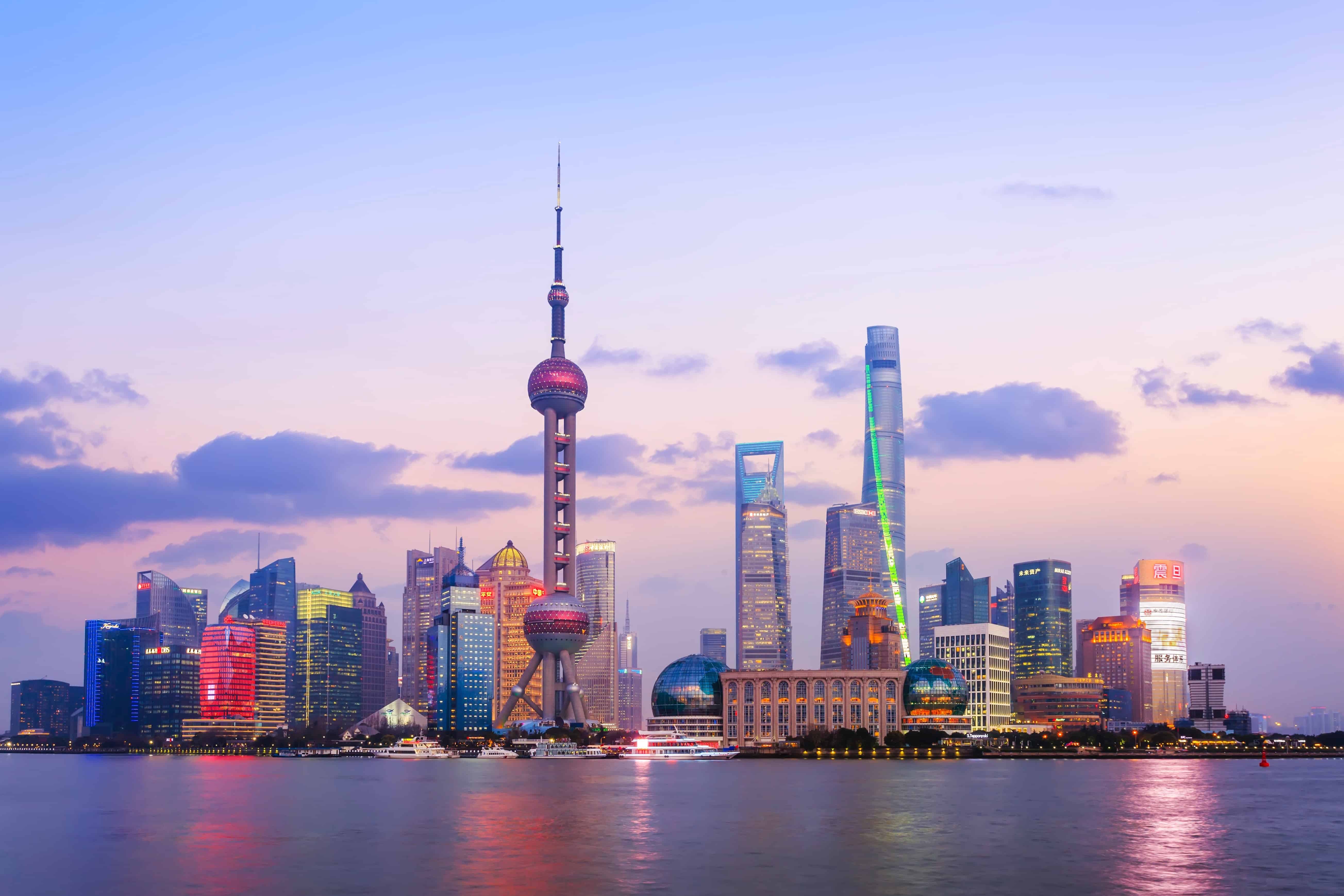
This is what an appropriately dense city looks like:
Also, FWIW, the anti-pattern (shanghai skyline) is the central business district of one of the most populated cities on earth (30+ million people). It wouldn't make sense to propose buildings anywhere that scale anywhere but a handful of very rich cities.
Even in Shanghai there's plenty of neighborhoods full of life at a human-appropriate scale. Just not at city center.
Right - but I think when we have these conversations people envision being "forced" to live in something that resembles that central business district, and I want to make it clear to others that at least in the interest circles I run in, this would be considered a bad idea too.
I question whether we should even have cities with 30 million people. That's probably a problem too. People like to point to what appears to be lower c02 emissions, but that's not the only metric that matters. Metrics that I care about would be something like independent farmers per-capita, bikes per-capita, distance of travel for produce, etc.
> People like to point to what appears to be lower c02 emissions, but that's not the only metric that matters.
On that note, central business districts & skyscrapers aren't actually that great environmentally, although the city model as a whole is much better environmentally than their suburban counterparts.
And it's certainly possible to build a dense, urban city housing even millions of people without a massive central business district. I think, more than anything, the central business district is an artifact of how we organize ourselves economically (IE the economy is dominated by relatively few massive corporations). This is harder to change but certainly not impossible.
Yes! I think it's a historical anomaly, product of nation states which we are just now (or perhaps we just were) winding down from. WW1 and WW2 begot General Electric, The European Union, IBM, the Chinese Communist Party, and the Central Business District which were needed to create the organizational scale and ability to conduct war on the nation state level.
When people left the military they went to familiar environments. You "paid your dues" just like a private did. You stayed with the same company. Etc. But that's all changing. Historically that was not the case (well historically we didn't really have companies for that long, but you get the point). So I think we will revert to a more natural flow, which is more decentralization and fragmentation. I think this is inevitable, but I wish/hope/want to avoid the waste of resources in creating these things in the first place.
... which clearly is not what encourages building a community like you imagine.
Before someone comes and says that I picked the worst image I could find ... nope. This is the standard for "affordable multi-story apartment housing" in my rather affluent country. In many parts we actively demolish them because no-one wants to live there (location is often semi-suburban) and because they are breed a social-problem-area.
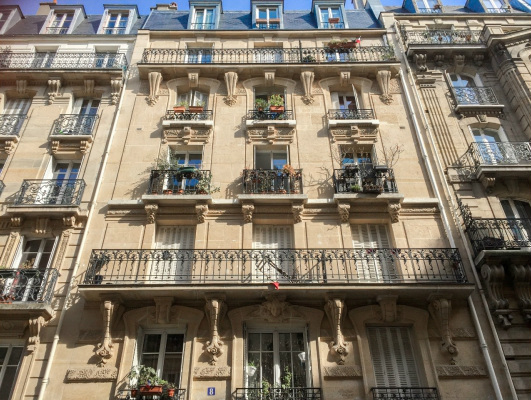
Couldn't agree more. We should stop building bullshit like that (i.e. modern style that is soulless and devoid of humanity) and instead just build great looking apartments. Typically people will say "oh but that's so expensive look at how much these cost" but they're expensive because we don't build them, and they are highly desirable.
These are just some random examples in Paris. We should build more like this. We can. There are no barriers. None.
Do things in your regular life that help the planet:
Don't drive; bike.
Don't eat meat.
Stop buying products you don't need.
Plant trees in your city.
Donate to climate action foundations.
You left out the most important action: vote for people who want to deal with the problem. Individual action is nice and all, but this is a problem that is caused collectively and needs to be dealt with collectively.




Please read Nuclear War: A Scenario, a book by Annie Jacobsen that discusses the insanity of nuclear war.
reply